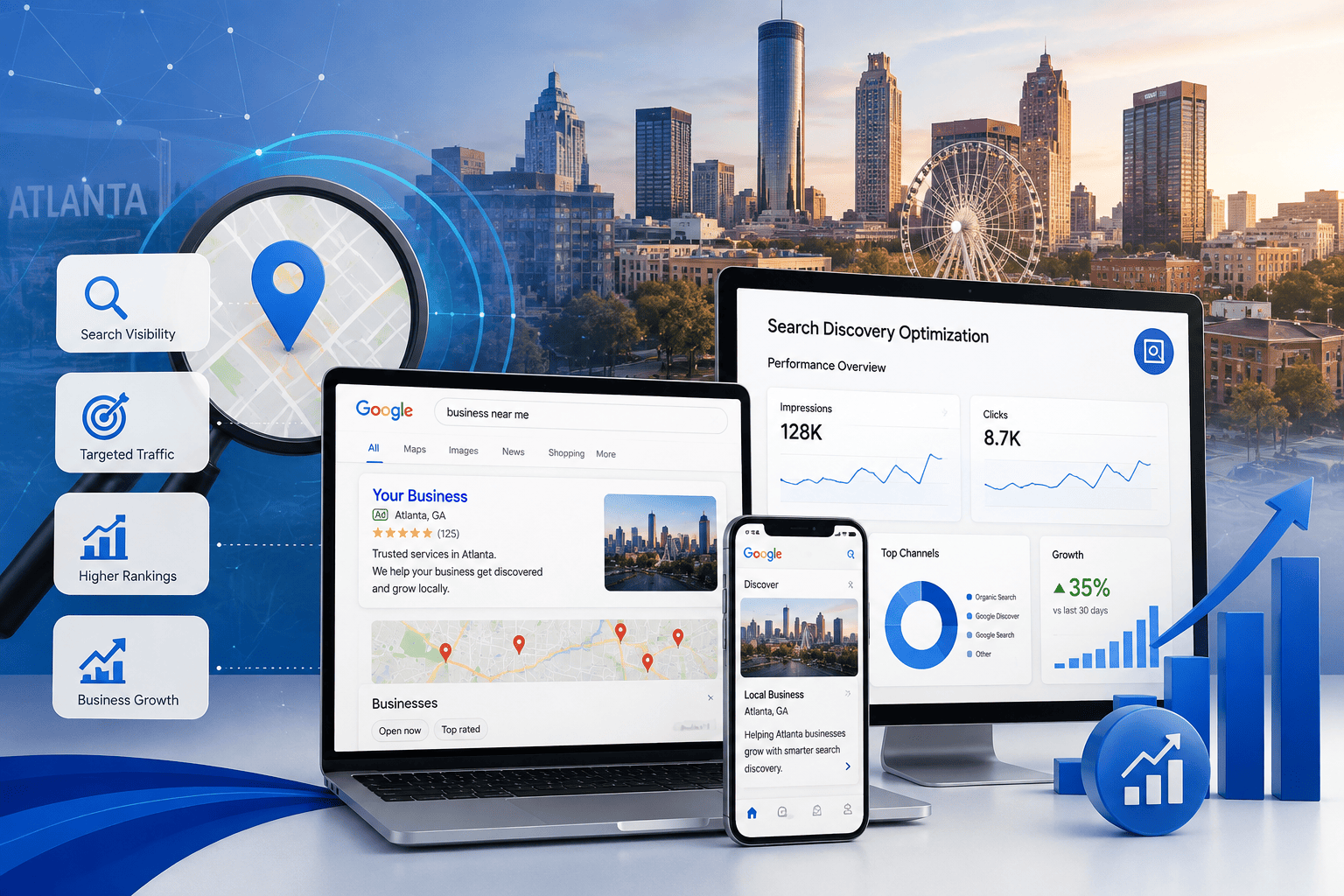
Search Discovery Optimization helps businesses become easier to find across the different channels people use to research services, compare providers, and make decisions. For Atlanta businesses, that journey may begin with a Google search, a map listing, an AI-generated answer, a social media post, an online directory, a video, or a customer review.
Customers rarely follow one predictable path. Someone may find a company through Maps, visit its website, read reviews, compare services, and return later. Incomplete or inconsistent information across those touchpoints may interrupt the journey.
Search Discovery Optimization, or SDO, connects these discovery channels around clear, useful, and trustworthy business information. This guide focuses on how Atlanta companies can apply that approach without treating every platform as a separate marketing project.
How Atlanta Customers Find and Evaluate Businesses
Traditional search engines remain important, but they are only one part of modern discovery. Atlanta customers may use Google Maps to find a nearby service, ask an AI assistant to compare options, search social media for examples, or review directory profiles before contacting a business.
The channel also changes with intent. A person may begin with an informational question, then search for local providers, compare services, check availability, and seek evidence of Atlanta-area experience.
Businesses must therefore provide useful information throughout the journey—not only on one ranking page. Search Discovery Optimization helps connect these moments so customers repeatedly encounter consistent information as they move closer to a decision.
Identify Gaps in Your Current Discovery Journey
Before creating more content, determine where potential customers are struggling to find or verify your business. A discovery audit should examine the website, business listings, map presence, reviews, social profiles, videos, directories, and other channels relevant to the audience.
Common gaps include:
- Services listed on the website but missing from external profiles
- Outdated hours, phone numbers, or addresses
- Important service pages that are difficult to reach
- Location pages with little useful local information
- Customer questions that remain unanswered
- Social profiles that describe the company differently
- Reviews that receive no response or context
- Content that attracts readers but offers no logical next step
These gaps weaken customer confidence and make the business harder for digital systems to understand. Correcting them may be more valuable than publishing uncoordinated content.
Organize Content Around the Customer’s Decision Process
Customers ask different questions as they move from awareness to action. An Atlanta company should organize content around these stages rather than concentrating only on direct service keywords.
Recognizing the Need
Early-stage content helps people understand a problem. Explanations, warning signs, checklists, and introductory guides can clarify the issue and identify an appropriate next step.
Exploring Possible Solutions
Users then compare approaches, services, processes, and alternatives. Comparison pages, process guides, service explanations, and FAQs should explain meaningful differences without unsupported claims.
Choosing a Provider
Decision-stage visitors look for location, experience, availability, reviews, service details, project examples, and contact options. High-intent pages should make these details easy to locate.
Connect Services With Accurate Atlanta Location Signals
Local discovery depends on more than repeatedly adding “Atlanta” to a page. Search platforms and customers need clear information about what the company offers, where it operates, and whether a particular service is available in that market.
A strong local structure may include:
- A complete contact or location page
- Accurate service-area information
- Service pages connected to relevant locations
- Consistent business details across major platforms
- Locally useful directions, scheduling, or availability information
- Original examples of work completed in the market
- Internal links between related services and resources
Avoid nearly identical pages for every neighborhood or nearby city. Each location page should have a genuine purpose and useful local information; changing only the city name offers little value.
Businesses with one physical office must also distinguish between their actual location and the areas they serve. Clear language prevents customers from assuming that the company has offices where none exist.
Make Business Information Consistent Across Platforms
Review the company name, address, phone number, website, service descriptions, hours, categories, and service areas wherever the business appears. Important profiles should reflect the same core facts while allowing the content format to suit each platform.
Consistency does not mean copying the same paragraph everywhere. It means that every channel presents the same identity, offerings, and location information. A social profile can use conversational language while a directory uses a concise description, but neither should contradict the website.
Use Local Evidence to Establish Relevance
Claiming to serve Atlanta does not demonstrate local experience. Customers need evidence that the company understands the market and can provide the promoted service.
Useful evidence may include:
- Atlanta-area case studies or project summaries
- Original photographs of completed work
- Reviews that mention a relevant service or experience
- Team expertise and professional credentials
- Explanations of locally relevant conditions
- Community participation when genuinely connected to the business
- Accurate examples drawn from customer questions
Evidence should be specific and verifiable. Avoid “best” or “most trusted” claims without support. Reviews also show how customers describe the company. Respond professionally and never encourage predetermined keywords.
Create Clear Connections Between Content and Services
Link educational articles to the most relevant service pages, related guides, or contact options. The destination must match the subject. A guide about local SEO should not direct readers to an unrelated social media service merely because that page needs more internal links.
Service pages should connect to supporting resources when they help customers understand the process. Calls to action should reflect intent: an early-stage reader may need another guide, while a decision-stage visitor may be ready for a consultation.
Coordinate Discovery Across Relevant Channels
SDO does not require participation on every platform. The right mix depends on the audience, industry, content, and resources.
A professional service company may prioritize its website, Google Business Profile, directories, reviews, and LinkedIn. A retailer or visually oriented company may benefit more from maps, images, videos, and social platforms.
Choose channels based on customer research habits and maintain them properly. A focused set of accurate profiles is more useful than several incomplete ones.
Measure Whether Discovery Produces Business Results
Rankings alone do not show the complete customer journey. Search Discovery Optimization should be evaluated through visibility, engagement, and qualified actions across multiple sources.
Depending on the business, useful measurements may include:
- Branded and non-branded search activity
- Google Business Profile calls, clicks, and direction requests
- Website visits from maps, directories, social media, and referrals
- Engagement with service and location pages
- Calls, forms, bookings, or purchases
- Assisted conversions involving multiple channels
- Lead quality and completed sales
- Mentions or citations in AI experiences when reliable data is available
Tracking should connect marketing activity with meaningful outcomes. A large increase in impressions has limited value if it does not help the right audience find, evaluate, or contact the business.
Build an Atlanta SDO Action Plan
Businesses can begin improving discovery without rebuilding their entire digital presence.
- Document core facts: Confirm the official name, services, location, service areas, contact information, and hours.
- Audit priority channels: Review the website, map listings, directories, reviews, and active social profiles.
- Map customer questions: Group questions by awareness, comparison, and decision stages.
- Strengthen important pages: Improve service, location, contact, and high-performing informational pages first.
- Add credible evidence: Incorporate relevant examples, reviews, expertise, and original media.
- Connect the journey: Use internal links and suitable calls to action to guide customers forward.
- Measure qualified actions: Monitor calls, forms, bookings, sales, and lead quality—not visibility alone.
Review the plan regularly because services, customer behavior, platforms, and business information can change.
Frequently Asked Questions
Can SDO help a business with only one Atlanta location?
Yes. A single-location company can improve how consistently its services, address, operating details, and expertise appear across relevant discovery channels. It should not create or imply additional offices to gain visibility.
Does my business need pages for every Atlanta neighborhood?
Not necessarily. Create a location page only when it serves a distinct audience and provides useful, original information. Near-duplicate neighborhood pages can make the website repetitive without improving the customer experience.
How do customer reviews support discovery?
Reviews provide recent, experience-based information that customers may consider when comparing businesses. They can also reveal common questions, valued services, and language customers naturally use when describing their needs.
Which business details should remain consistent online?
Keep the business name, address, phone number, website, hours, services, and location status accurate. Descriptions can vary by platform, but the underlying facts should not conflict.
Can an Atlanta agency support businesses outside Georgia?
Yes. The strategy should reflect the locations and audiences the company actually serves. Businesses should use accurate market information rather than adding Atlanta signals when Atlanta is not a genuine target.
How often should discovery content be reviewed?
Review high-value pages and business profiles whenever services, locations, hours, or customer needs change. Periodic audits can also identify outdated claims, broken paths, and new questions that deserve coverage.
Strengthen How Customers Discover Your Business
Search Discovery Optimization brings content, local information, customer evidence, and relevant platforms into a connected discovery journey. For Atlanta businesses, the goal is not to appear everywhere. It is to provide accurate and useful information wherever the right customers are most likely to search, compare, and decide.
TopLine Media Group offers Search Discovery Optimization and other digital marketing services designed around each company’s goals and audience. If you want to strengthen how customers find and evaluate your business, contact TopLine Media Group to request a customized strategy and proposal.