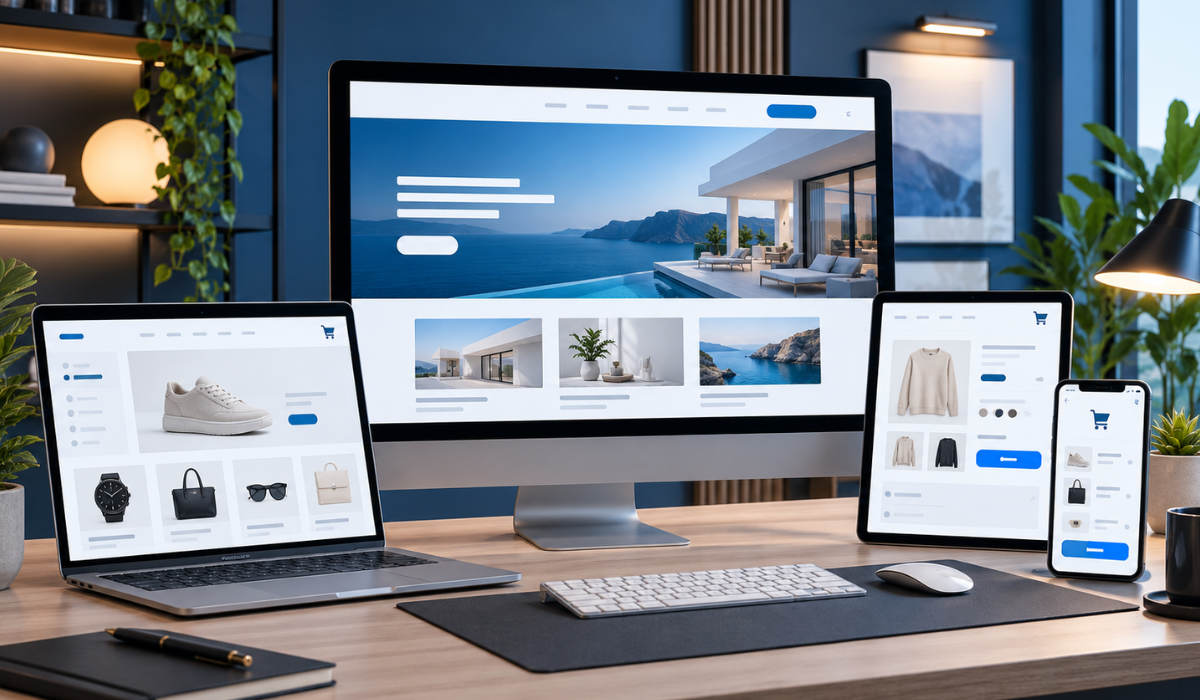
The best website designers combine strategy, custom design, responsive development, ecommerce functionality, technical SEO, security, analytics, and ongoing support.
A North Druid Hills business should choose a team based on relevant project experience, a clearly defined process, measurable performance standards, ownership terms, and its ability to support the website after launch.
Quick Facts
- ✓WordPress powers approximately 40% of all websites, according to W3Techs data available in 2026.
- ✓North Druid Hills had 20,385 residents in the 2020 Census.
- ✓Google recommends an LCP of 2.5 seconds or less for a good loading experience.
- ✓Google recommends an INP of 200 milliseconds or less for responsive interaction.
- ✓A professionally planned business website commonly requires approximately 8 to 16 weeks, depending on its scope and approval process.
What Should a Professional Website Design Company Provide?
A professional website design company should provide strategy, user-experience planning, responsive design, development, testing, launch support, analytics configuration, and ongoing maintenance.
A proposal limited to colors, images, and page counts does not fully address website performance.
The project scope should identify responsibilities and deliverables in areas such as:
- Business and audience research
- Sitemap and page planning
- Wireframes or design mockups
- Mobile-responsive layouts
- Copywriting and content migration
- WordPress or ecommerce development
- Forms, checkout, CRM, and platform integrations
- Technical SEO and structured data
- Accessibility considerations
- Analytics and conversion tracking
- Browser and device testing
- Hosting, security, backups, and maintenance
- Training and post-launch support
Google’s Core Web Vitals provide measurable performance benchmarks. A good user experience generally means an LCP within 2.5 seconds, an INP of 200 milliseconds or less, and a CLS score of 0.1 or less, measured at the 75th percentile of page loads.
Professional designers should understand these measurements and explain how images, scripts, hosting, layouts, and third-party tools may affect them.
Should Your Business Choose WordPress or an Ecommerce Platform?
WordPress is suitable for many content-driven, lead-generation, and customizable business websites, while a dedicated ecommerce platform may be preferable when advanced product, inventory, checkout, or multichannel selling requirements drive the project.
The choice should follow the required functions rather than platform popularity alone.
| Consideration | WordPress | Dedicated Ecommerce Platform |
|---|---|---|
| Primary use | Content, services, lead generation, flexible commerce | Product sales and commerce operations |
| Content control | Highly flexible | Varies by platform |
| Ecommerce capability | Commonly added through WooCommerce or custom tools | Usually included in the core platform |
| Customization | Extensive, depending on the build | May be limited by platform architecture |
| Maintenance | Requires managed updates and security | More platform maintenance may be managed |
| Ownership and portability | Generally offers substantial control | Depends on provider and contract |
| Best fit | Businesses needing content and flexible functionality | Retailers prioritizing catalog and checkout management |
WordPress was used by approximately 40% of all websites in W3Techs reporting available in 2026, demonstrating its widespread adoption. Popularity, however, does not guarantee that it is the right platform for every business.
Companies considering a tailored build can review the features available through custom WordPress website development, including custom navigation, integrations, permissions, scalability, and content presentation.
Need help selecting a platform before committing to a build?Call TopLine Media Group to discuss your website’s content, ecommerce, integration, and growth requirements. | Book a 15-Minute Call |
What Should You Look for in a WordPress Website Designer?
A qualified WordPress designer should understand design, development, performance, security, content management, integrations, and technical SEO. Familiarity with installing a theme is not equivalent to planning and building a dependable business website.
Look for evidence of the following:
- Custom layouts aligned with the brand and customer journey
- Mobile and cross-browser testing
- A manageable editor experience for internal staff
- Limited dependence on unnecessary plugins
- Secure user roles, backups, and update procedures
- Clear hosting and maintenance responsibilities
- Clean navigation and logical URL structures
- Proper redirects during a redesign
- Search-friendly metadata, headings, schema, and internal links
- Form, call, purchase, and lead tracking
- Documentation and staff training
- Clear ownership of the website, content, and accounts
Ask whether the designer builds only the visible layout or also handles the technical systems behind it.
A visually attractive site can still fail if forms do not record submissions, old URLs return errors, mobile menus are difficult to use, or business owners cannot update the content.
TopLine Media Group’s SEO services address search intent, crawlability, structured content, technical optimization, and performance reporting.
Website design and SEO should be coordinated early because navigation, templates, content hierarchy, page speed, and URL decisions can affect organic visibility.
What Does an Ecommerce Website Development Company Need to Understand?
An ecommerce website development company must understand the entire purchasing journey, from product discovery to payment, fulfillment, support, and repeat purchases.
Designing product pages without planning the underlying commercial workflow can create expensive operational problems.
An ecommerce scope may need to cover:
- Product categories and filters
- Product variations and inventory rules
- Customer and wholesale accounts
- Tax and shipping calculations
- Payment gateway configuration
- Discount and promotional rules
- Abandoned-cart workflows
- CRM, email, accounting, and fulfillment integrations
- Refund and return processes
- Product schema and merchant data
- Security and payment requirements
- Analytics and ecommerce event tracking
B2B ecommerce may also require company-specific pricing, bulk ordering, quote requests, purchase orders, approval roles, and account-based catalogs.
The requirements differ significantly from those of a small direct-to-consumer store.
Businesses evaluating complex commerce features can review why B2B ecommerce website development supports business growth.
Security must be planned from the beginning. The Payment Card Industry Security Standards Council publishes requirements and guidance for organizations that accept or process payment cards.
The applicable responsibilities vary according to the platform, payment flow, vendors, and cardholder-data environment.
How Does the Website Design and Development Process Work?
A structured website project moves from discovery and planning through design, development, testing, launch, and post-launch improvement.
Each phase should have defined deliverables, decision-makers, and approval deadlines.
A typical process includes:
- Discovery and goal setting: Define audiences, services or products, competitors, conversion goals, integrations, and success measurements.
- Content and technical audit: Review existing pages, rankings, analytics, backlinks, forms, ecommerce data, and technical limitations.
- Sitemap and requirements planning: Establish the navigation, page inventory, content needs, functionality, and platform.
- Wireframing and content development: Organize page sections and prepare copy around visitor questions and conversion goals.
- Visual design: Apply brand colors, typography, imagery, spacing, and interface components.
- Development and integration: Build templates, responsive layouts, forms, ecommerce systems, analytics, schema, and third-party connections.
- Quality assurance: Test browsers, screen sizes, links, redirects, forms, checkout, accessibility features, speed, and tracking.
- Launch and monitoring: Publish the website, submit essential search files, verify tracking, monitor errors, and address launch issues.
- Ongoing optimization: Use search, behavior, lead-quality, and sales data to improve pages after launch.
Current website planning also needs to account for AI-assisted discovery, accessibility, personalization, and conversion-focused experiences.
TopLine Media Group’s overview of website development trends for 2026 explains how these requirements are influencing modern builds.
How Much Does Professional Website Design Cost?
Professional website design does not have one standard price because page count alone does not determine the required work.
Platform selection, custom layouts, content, ecommerce requirements, integrations, data migration, accessibility, SEO, and post-launch support all affect the proposal.
A five-page informational site and a five-template ecommerce site can require very different levels of planning and development. A useful proposal should separate:
- Strategy and research
- Design
- Copywriting or content migration
- Development
- Ecommerce or custom functionality
- Third-party integrations
- SEO migration
- Analytics and conversion tracking
- Hosting and software costs
- Maintenance and support
- Optional future work
Businesses should compare the scope, not simply the final total. A lower quote may exclude copywriting, redirects, product entry, analytics, hosting, maintenance, or training.
Those omissions can produce additional costs after the project begins.
Request an itemized proposal and ask how change requests are priced. Confirm whether the business will own the domain, website files, content, analytics properties, advertising tags, and administrative accounts.
For a project-specific scope and quote, call TopLine Media Group at 404-617-9953 or contact the team with your required pages, functionality, integrations, and launch goals.
How Long Does It Take to Design and Launch a Website?
A small, well-defined business website may require approximately 6 to 10 weeks, while a custom WordPress or ecommerce project commonly requires 8 to 16 weeks or longer. The actual schedule depends on functionality, content readiness, integrations, feedback, and approval speed.
| Project type | General planning range |
|---|---|
| Small informational website | 6 to 10 weeks |
| Custom lead-generation website | 8 to 14 weeks |
| Standard ecommerce website | 10 to 16 weeks |
| Complex B2B or integrated ecommerce site | 16 weeks or longer |
These ranges are planning estimates, not guaranteed completion times. The website team should establish a project schedule after documenting the full scope.
Delays frequently occur when product information is incomplete, website copy is not approved, decision-makers provide conflicting feedback, or integrations are discovered after development begins.
A realistic timeline includes time for content, testing, revisions, and launch preparation rather than treating the project as design work alone.
Which Website Design Myths Can Lead to Poor Decisions?
Website design myths can cause businesses to prioritize appearance or initial price while overlooking performance, ownership, security, and long-term maintenance.
Myth: A Beautiful Website Will Automatically Generate Leads
Fact: Visual quality helps establish credibility, but lead generation also depends on the offer, content, traffic quality, page speed, user journey, calls to action, forms, and follow-up process.
Myth: WordPress Websites Are Automatically Slow
Fact: Performance depends on the theme, hosting, images, plugins, scripts, caching, database management, and development quality. A carefully built WordPress website can deliver strong performance.
Myth: Ecommerce Development Ends When Checkout Works
Fact: A dependable store also requires product data, inventory logic, shipping, tax configuration, payment security, analytics, customer communications, testing, and ongoing maintenance.
Myth: The Lowest Quote Provides the Most Affordable Website
Fact: A low initial price may exclude essential work or create future rebuilding costs. Long-term value depends on the scope, reliability, ownership, scalability, and support provided.
Myth: SEO Can Be Added After the Website Launches
Fact: Search considerations should influence the sitemap, URLs, content, templates, internal links, mobile performance, schema, redirects, and analytics before launch.
How Should a North Druid Hills Business Compare Website Designers?
A North Druid Hills business should compare designers using consistent questions, written evidence, and project-specific criteria.
Portfolios are helpful, but they should not replace a detailed review of process, functionality, performance, and ongoing responsibilities.
Ask each prospective website designer:
- Have you built websites with similar functions or customer journeys?
- Who will manage strategy, design, development, SEO, and communication?
- Is the work completed in-house or outsourced?
- Which platform do you recommend, and why?
- How will mobile usability and Core Web Vitals be addressed?
- What content, images, and product data must we provide?
- How will existing rankings and URLs be protected during migration?
- Which conversions will be tracked?
- What testing occurs before launch?
- Who owns the domain, code, content, accounts, and data?
- What training and documentation are included?
- What happens when the website needs updates or repairs?
A reliable provider should explain tradeoffs instead of recommending the same platform and package for every client.
It should also be willing to define exclusions, dependencies, and ongoing costs in writing.
What Should a Business Do Before Requesting a Website Proposal?
A business should define its goals, required functionality, content responsibilities, budget expectations, decision-makers, and desired launch period before requesting proposals.
Clear preparation makes quotes easier to compare and reduces scope changes.
Use this pre-proposal checklist:
- Identify the website’s main business goal.
- List the services, products, and audiences it must support.
- Identify required forms, checkout features, portals, or integrations.
- Gather examples of websites you like and explain why.
- Review the existing website’s pages, traffic, leads, and rankings.
- Decide who will prepare and approve the content.
- Identify legal, privacy, accessibility, or industry requirements.
- Confirm who will provide photography and visual assets.
- Establish the internal decision-maker.
- Define a realistic launch window.
- Request ownership, hosting, maintenance, and support terms in writing.
- Ask how website success will be measured after launch.
This preparation helps the designer recommend an appropriate platform and create a more accurate scope.
Conclusion
The best website designers for WordPress and ecommerce are not determined by appearance, awards, or the lowest quote alone.
The right team should understand business strategy, user experience, mobile design, content management, ecommerce operations, technical SEO, security, analytics, and ongoing improvement.
For North Druid Hills businesses, the strongest choice is a partner that can build for local visibility while supporting customers throughout Decatur, Brookhaven, Buckhead, Druid Hills, and the Atlanta area.
Compare written scopes carefully, verify ownership terms, and select a team whose technical approach matches the website’s business purpose.
Need a Webiste Design Plan for your Current Budget?Call TopLine Media Group at 404-617-9953 or contact us to request a website consultation and customized quote for your WordPress, lead-generation, or ecommerce project. | Book a 15-Minute Call |
Frequently Asked Questions
Is WordPress Suitable for a Small Business Website?
Yes, WordPress can support service pages, blogs, lead forms, appointment tools, memberships, and ecommerce functionality. Its suitability depends on how the website is configured, secured, hosted, and maintained.
Can WordPress Be Used for Ecommerce?
Yes, WordPress is commonly combined with WooCommerce or other commerce tools to manage products, payments, shipping, taxes, and customer accounts. The specific configuration should match the store’s catalog and operational requirements.
Should I Hire a Local Website Designer?
A local designer can offer useful market familiarity and easier collaboration, but location should not be the only factor. Relevant experience, technical skill, communication, project management, ownership terms, and support are more important than proximity alone.
Will I Be Able to Update My Website Myself?
You should be able to update routine content when the website includes an appropriate CMS, user permissions, documentation, and training. Confirm which changes your team can manage and which require developer assistance.
Does a New Website Automatically Improve Google Rankings?
No, a redesign can create a stronger technical and content foundation, but rankings depend on relevance, quality, authority, competition, crawlability, user experience, and migration accuracy. Poor URL or redirect handling can reduce existing visibility.
What Is the Difference Between a Web Designer and a Web Developer?
A web designer focuses primarily on layout, visual presentation, user experience, and interface decisions. A developer builds the templates, functionality, integrations, databases, and technical systems that make the design work.
Does an Ecommerce Website Need Ongoing Maintenance?
Yes, Ecommerce websites require software and security updates, backups, payment and integration monitoring, product changes, performance checks, analytics review, and testing. Maintenance responsibilities should be established before launch.
What Information Should I Provide to Get a Website Quote?
Provide your goals, required pages, product count, functionality, integrations, content needs, existing website, examples, desired launch period, and maintenance expectations. More complete requirements generally produce a more accurate proposal.