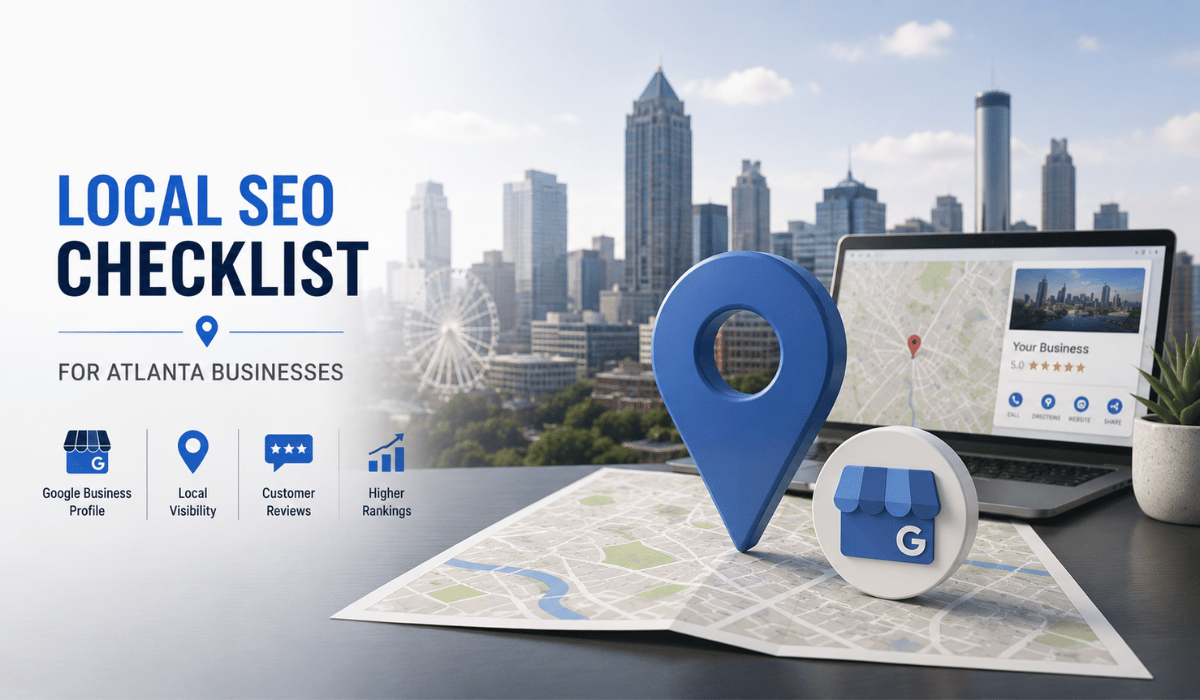
Local SEO in Atlanta helps potential customers find nearby products and services online before visiting a physical location, making a call, or scheduling an appointment.
If your business serves a specific area, optimizing your website and online presence for local searches is essential for reaching people when they are ready to take action.
Google gives importance to prominence, distance, and relevance while showing results based on local searches.
It is important for any business to improve their website so that it becomes visible online.
This guide includes a local SEO checklist for businesses running in Atlanta and ensures that as a business owner, you can understand what improves the local visibility, and encourages your customers to think of your business.
1. Build a Complete Google Business Profile
Your Google Business Profile helps Google understand your company and display it in local and Maps results. Claim and verify your profile, then complete it with accurate information:
- Use your official business name without adding keywords.
- Choose the correct primary and secondary categories.
- Add your address or service area.
- Provide your phone number and website URL.
- Include booking or service links when relevant.
- Update regular and holiday hours.
- Describe your products and services.
- Upload authentic business photos.
- Publish updates, events, services, and offers regularly.
2. Check Your Business Information Across the Web
Keep your business name, address, and phone number (NAP) consistent across your website, Google Business Profile, directories, and social platforms. Conduct a citation audit to identify:
- Incorrect phone numbers
- Previous business addresses
- Duplicate listings
- Misspelled business names
- Outdated website links
- Inaccurate operating hours
Use a standardized format across all listings. Tools such as BrightLocal, Moz Local, and Whitespark can help locate inconsistencies.
3. Improve Your Website’s Local Search Signals
Your website should clearly explain what your business offers and which areas it serves. This helps search engines connect your pages with relevant local searches.
For important service pages:
- Include the service and location naturally in the title tag.
- Write an H1 that accurately describes the page.
- Mention Atlanta or the relevant service area in the introduction.
- Use location-specific terms where they fit the context.
- Create helpful content that answers the visitor’s questions.
- Add a clear phone number, contact form, or booking option.
- Include accurate business information in the footer or contact section.
For example, a phrase such as “emergency plumbing services in Atlanta” communicates stronger local intent than the general term “plumbing services.”
4. Strengthen Your Mobile Experience
Many customers conduct local searches while using their smartphones. They may need directions, want to compare nearby providers, or be ready to make an immediate call.
A confusing or slow mobile website can cause those visitors to leave before contacting your business.
Review the following elements:
- Responsive design across different screen sizes
- Easily readable text
- Simple navigation
- Functional contact forms
- Prominent click-to-call buttons
- Properly compressed images
- Fast-loading service and location pages
- Stable page elements that do not shift while loading
Use Google PageSpeed Insights to identify performance problems. Pay attention to Core Web Vitals, including Largest Contentful Paint, Interaction to Next Paint, and Cumulative Layout Shift.
Page speed supports SEO, but it also affects usability and conversions. Prioritize improvements that make the website easier for actual customers to use.
5. Create Valuable Pages for Individual Locations
Businesses serving multiple offices or distinct markets may benefit from a dedicated page for each location. These pages allow you to present information that is specific to the customers in that area.
Each location page should contain:
- A descriptive and readable URL
- A unique title tag and H1
- The correct local address and phone number
- Business hours for that location
- A Google Map when useful
- Services available at that location
- Neighborhoods or nearby communities served
- Original information about the office or service area
- Relevant customer testimonials, when available
- Clear directions or parking information for physical locations
Avoid duplicating the same content across numerous pages and changing only the city name. Every page should provide enough original information to be valuable on its own.
6. Earn and Manage Customer Reviews
Reviews can influence local visibility and customer decisions. A steady flow of recent, authentic feedback may help demonstrate that your business remains active and trusted by its customers.
Develop a simple process for requesting reviews after:
- Completing a service
- Delivering a product
- Resolving a customer concern
- Receiving positive feedback
- Reaching an appropriate stage in the customer relationship
Send customers a direct review link by email or text to make the process convenient.
Respond professionally to both positive and negative feedback. Thank customers for positive comments and address complaints without becoming defensive or sharing confidential information.
Never purchase reviews, offer rewards in exchange for positive ratings, or prevent dissatisfied customers from leaving feedback. Such practices can violate platform policies and damage credibility.
7. Add Your Business to Relevant Directories
A local citation is an online reference to a company’s identifying information. Accurate citations can help search engines verify that the business is legitimate and associated with a specific geographic area.
Depending on your industry, useful platforms may include:
- Apple Business Connect
- Bing Places for Business
- Yelp
- Better Business Bureau
- Local chambers of commerce
- Professional associations
- Established industry directories
Industry relevance is important. A contractor may benefit from a recognized home-services platform, while an attorney or healthcare provider should focus on reputable directories within their own field.
8. Publish Content for an Atlanta Audience
Localized content can help your website address topics that matter to customers in Atlanta. It also allows your business to demonstrate familiarity with the region rather than publishing generic advice.
Potential topics include:
- Atlanta-specific service challenges
- Seasonal maintenance recommendations
- Local regulations that affect your industry
- Guides for individual neighborhoods
- Community events involving your business
- Projects completed in the Atlanta area
- Partnerships with local organizations
- Answers to questions frequently asked by local customers
For example, an Atlanta roofing company could explain how heat, humidity, storms, and tree coverage may affect local roofing systems. This provides more regional value than a broad article about roof maintenance.
Every topic should still relate to your services and audience. Publishing unrelated local news simply to mention Atlanta is unlikely to attract qualified customers.
9. Implement Local Business Schema
Schema markup is structured information added to a website’s code. It helps search engines interpret details about the business more accurately.
Applicable LocalBusiness schema may include:
- Business name
- Address
- Phone number
- Website URL
- Logo
- Business type
- Opening hours
- Geographic coordinates
- Areas served
- Social profile links
Choose the most specific schema type that accurately represents your business. For example, a restaurant, legal practice, or home-services provider may have a more appropriate subtype than the general LocalBusiness category.
Schema does not guarantee higher rankings or enhanced search features. Its main purpose is to clarify information for search engines.
After implementation, validate the markup using Google’s Rich Results Test or the Schema Markup Validator.
10. Build Links Within the Local Community
Backlinks from established Atlanta organizations can strengthen your website’s local relevance and authority. These links are most valuable when they result from genuine relationships, partnerships, or noteworthy activities.
Possible local link-building opportunities include:
- Joining an Atlanta business association
- Becoming a member of a local chamber of commerce
- Sponsoring a community event or sports organization
- Supporting a local nonprofit
- Contributing expert insight to a regional publication
- Partnering with complementary businesses
- Participating in industry events
- Publishing useful research or community resources
Focus on earning links from reputable and relevant websites. A natural link from a respected local organization can carry more value than numerous links from unrelated directories.
Avoid purchasing large link packages or participating in schemes designed only to manipulate rankings.
11. Prepare Content for Conversational Searches
People often phrase spoken searches differently from typed searches. A typed query may be “Atlanta HVAC repair,” while a voice search might be “Who repairs air conditioners near me?”
To support conversational and voice-based searches:
- Use natural language throughout your content.
- Answer common customer questions directly.
- Add useful FAQ sections to relevant pages.
- Keep business hours and contact details current.
- Explain service areas clearly.
- Write concise answers beneath question-based headings.
- Ensure pages load quickly on mobile devices.
Voice search does not require a completely separate SEO campaign. It depends on the same fundamentals: clear content, accurate local information, mobile usability, and a well-maintained Google Business Profile.
12. Measure Local SEO Results
Local SEO should be monitored regularly to determine which improvements are generating visibility, engagement, and leads.
Useful performance indicators include:
- Rankings for location-based service terms
- Google Maps visibility
- Google Business Profile interactions
- Website clicks from the business profile
- Phone calls and appointment requests
- Direction requests
- Organic traffic to service and location pages
- Form submissions from local visitors
- Number and recency of customer reviews
- Accuracy of directory listings
- Locally relevant backlinks
Google Search Console can show which queries bring visitors to your website. Google Analytics can help track engagement and conversions, while Google Business Profile performance data provides information about profile interactions.
Review these metrics monthly and compare changes over a longer period. Local SEO generally develops over time, so decisions should not be based on a few days of data.
Conclusion
A successful local SEO strategy combines an accurate Google Business Profile, a well-optimized website, consistent business information, useful local content, authentic reviews, and regular performance tracking.
Completing this checklist can help Atlanta businesses improve their online presence and connect with customers searching for relevant local services.
Want to Create a Local SEO Checklist for Your Business?
TopLine Media Group provides affordable SEO services tailored to your website, market, and growth objectives. Contact us to discuss how we can improve your local visibility, attract more qualified customers, and support your business growth in Atlanta.
Frequently Asked Questions
Can I do Local SEO Myself?
You can manage local SEO yourself if you have the necessary knowledge and time. However, it requires consistency, specialized skills, and an understanding of changing search trends. Another option is to hire a trusted digital marketing agency in Atlanta that offers affordable SEO services tailored to your business needs.
How Much Does Local SEO Cost in Atlanta?
Local SEO pricing varies according to the number of locations, services, competitors, and technical issues involved. Affordable SEO services should include clearly defined deliverables, transparent reporting, and a strategy aligned with your business goals—not simply the lowest available price.