
AI in SEO is changing how businesses research keywords, plan content, optimize pages, analyze competitors, and manage search visibility.
In 2026, U.S. small businesses, startups, marketing teams, and growing brands can use AI to make SEO work faster and more organized. However, AI should support strategy, not replace it.
Search engine optimization still depends on helpful content, technical quality, audience understanding, accurate information, and strong business positioning.
Google’s guidance continues to focus on helpful, reliable, people-first content, and it says content quality matters more than how the content is produced.
That means AI can be useful, but it must be guided carefully.
A strong AI SEO strategy uses AI tools for research, planning, optimization, and workflow support while keeping human review at the center of decisions.
What Does AI in SEO Mean in 2026?
AI in SEO means using artificial intelligence to support search engine optimization tasks.
These tasks may include keyword research, topic clustering, content briefs, metadata drafts, content audits, internal linking ideas, technical summaries, competitor analysis, and reporting support.
AI can help businesses move faster, especially when teams need to organize large amounts of search data.
Instead of manually sorting hundreds of keywords, AI SEO tools can help group topics by intent, audience, funnel stage, or service category. This can make the planning process more efficient.
However, AI-driven SEO should not mean automated publishing without review.
SEO still needs human judgment to decide which topics matter, which keywords support business goals, and how content should speak to the target audience.
AI search optimization is also becoming more important because users now discover information through traditional Google results, AI Overviews, AI Mode, ChatGPT, Gemini, Perplexity, and other answer-style platforms.
Google states that the same foundational SEO best practices apply to AI features in Search, with no extra technical requirements beyond being eligible for Google Search and snippets.
How AI Is Changing SEO in 2026
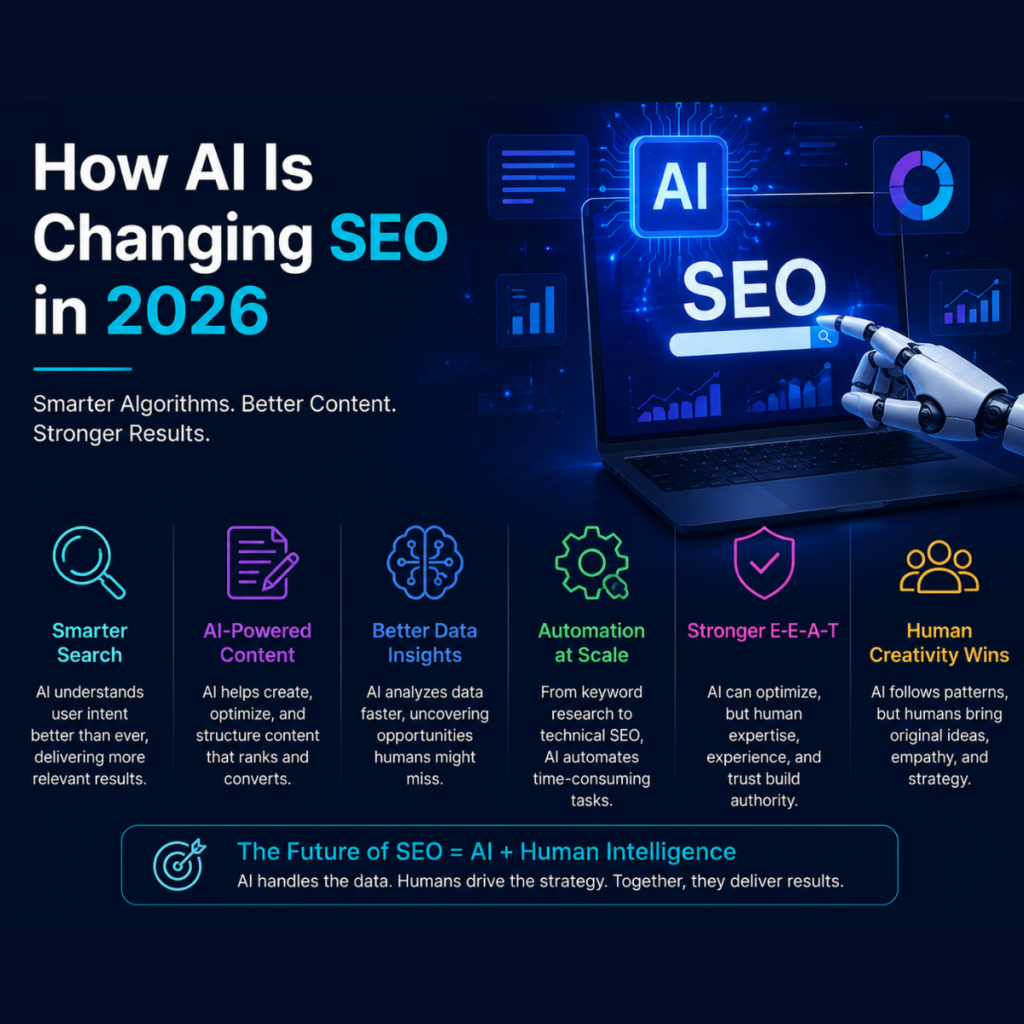
AI is changing SEO by speeding up tasks that used to take more manual time.
It can support research, content planning, optimization, and workflow organization. For small businesses and marketing teams, this can make SEO more manageable.
Faster Keyword Research and Content Planning
AI keyword research can help identify keyword groups, content gaps, related questions, and search intent patterns.
This is useful when creating a content plan for service pages, blogs, guides, FAQs, or location pages.
For example, AI can help organize keywords into categories such as commercial intent, informational intent, local intent, and comparison intent.
This helps teams understand which keywords belong on service pages and which ones are better for educational content.
This is one of the clearest examples of how AI helps with keyword research and content planning.
It does not replace final keyword judgment, but it can make the early planning stage faster.
Better Content Briefs and Outlines
AI can help create structured content briefs with suggested H1, H2, H3, FAQs, internal linking ideas, and topic coverage.
This helps writers start with a clearer framework instead of a blank page.
An AI SEO workflow can also help maintain consistency across content.
For example, a team can use AI to create outlines for service pages, blog posts, comparison pages, and FAQ content while following the same structure.
However, every outline still needs review. AI may include irrelevant sections, repeat ideas, or miss important business-specific details.
Faster Content Optimization
AI content optimization can help identify missing sections, weak headings, unclear paragraphs, and FAQ opportunities.
AI SEO tools for content optimization may also suggest related topics or semantic terms that support the main subject.
This can be helpful for refreshing old content. Instead of rewriting everything, AI can help spot areas where content needs stronger structure, clearer answers, or better internal links.
Still, optimization should not become keyword stuffing.
Google’s Search Essentials recommends using words people would use to find content and placing them in prominent locations, but the content should remain helpful and reliable.
What Works in AI SEO Strategy
A practical AI SEO strategy uses automation where it saves time, but keeps humans in charge of quality, accuracy, and business direction.
AI Keyword Research and Topic Clustering
AI works well for organizing keyword lists into themes.
This is useful for businesses that want to build topic clusters around services, industries, locations, or buyer questions.
For example, a small business may have keywords related to SEO services, PPC, content marketing, website design, and local search.
AI can group those keywords into content categories and suggest which topics support service pages.
This helps create a stronger SEO strategy in 2026 because content can be planned around search intent and business relevance instead of random blog ideas.
AI-Assisted Content Briefs
AI can help create content briefs that include target keywords, section ideas, FAQs, and internal linking suggestions. This can save time for marketing teams and writers.
A good brief should still include human input, such as brand voice, audience pain points, service positioning, examples, and conversion goals.
AI can draft the structure, but the final direction should come from someone who understands the business.
AI Content Optimization
AI content optimization works best when used to improve clarity, structure, and completeness.
It can help identify thin sections, suggest better headings, and recommend additional FAQs.
Using AI for SEO content without keyword stuffing requires clear instructions.
The goal should be helpful content, not repeating the same keyword too many times.
SEO Automation for Repetitive Tasks
SEO automation can help with repetitive tasks such as metadata drafts, reporting summaries, keyword grouping, content summaries, and technical issue explanations.
This saves time, especially for small teams. But automation should not make final decisions on strategy, publishing, or quality. Those decisions still need human review.
What Does Not Work in AI SEO
AI can create problems when businesses use it without oversight.
The biggest risks come from publishing too fast, removing human review, and treating AI output as finished content.
Publishing AI-Generated Content Without Review
AI-generated content can be generic, repetitive, inaccurate, or too similar to existing information online. It may sound polished but still lack originality, expertise, or useful detail.
AI-generated content and SEO performance depend on the final quality of the page.
Google’s guidance says its systems aim to reward original, high-quality content that demonstrates expertise, experience, authoritativeness, and trustworthiness.
This means AI-assisted content can work, but only when it is reviewed, improved, and made genuinely useful.
Relying on AI for Strategy
AI can suggest topics, but it does not fully understand a company’s sales process, customer objections, service priorities, local market, or competitive positioning.
This is why human input in AI SEO strategy is still necessary.
For example, AI may suggest a blog topic that has search volume but does not support the business’s services.
A human strategist can decide whether that topic is worth targeting or whether it distracts from stronger lead-generation opportunities.
Keyword Stuffing With AI Content
AI can overuse keywords if the prompt is too aggressive.
This can make content sound unnatural. Search content should use keywords clearly but naturally.
A page about AI in SEO should not repeat the primary keyword in every paragraph.
Instead, it should include related terms such as AI SEO strategy, AI content optimization, AI keyword research, AI SEO tools, and human-led SEO where they fit naturally.
Creating Large Volumes of Low-Value Pages
One of the biggest risks is using AI to create many pages without adding real value.
Google’s spam policies describe scaled content abuse as generating many pages mainly to manipulate rankings rather than help users, including pages created with generative AI tools when they add little value.
This is why businesses should avoid mass-producing thin AI pages. Quality, usefulness, and originality matter more than volume.
Where Human SEO Input Is Still Required
AI can support SEO, but human-led SEO is still needed for strategy, judgment, accuracy, and trust.
Strategy and Business Positioning
AI can suggest keywords, but humans must decide which services, audiences, and goals matter most.
A business may not need every keyword with search volume. It needs keywords that support qualified traffic, leads, and revenue.
An AI SEO strategy that still needs human review includes service page planning, local targeting, conversion strategy, content prioritization, and brand positioning.
Accuracy and Fact-Checking
AI can make mistakes or create outdated information.
Human review is essential for checking facts, claims, examples, statistics, legal statements, medical information, pricing, product details, and service descriptions.
This matters even more for industries where accuracy affects trust, such as healthcare, finance, legal, technology, and professional services.
Brand Voice and Originality
AI may create content that sounds generic. Humans are needed to make the content sound like the brand and reflect real experience.
Originality matters because users do not need another generic page.
They need clear answers, useful examples, practical advice, and reasons to trust the business.
Experience, Expertise, and Trust
AI and human expertise in search engine optimization work best together.
AI can support research and structure, but humans add judgment, examples, experience, and insight.
Google’s helpful content guidance encourages creators to evaluate whether content is useful, reliable, and made for people rather than created mainly to manipulate rankings.
AI SEO Strategy for Small Businesses
AI integration in an SEO strategy for small businesses can be very useful when budgets and time are limited.
Smaller teams can use AI to speed up planning, organize ideas, and improve content workflows.
How Small Businesses Can Use AI Efficiently
Small businesses can use AI for:
- Keyword grouping
- Blog topic ideas
- Content outlines
- FAQ expansion
- Meta title drafts
- Meta description drafts
- Internal linking suggestions
- Content refresh ideas
- Competitor content summaries
- Reporting summaries
This helps small teams stay organized and consistent without spending too much time on manual tasks.
What Small Businesses Should Not Fully Automate
Small businesses should not fully automate final publishing, service positioning, customer-facing claims, local market messaging, or conversion strategy.
Knowing how to use AI in SEO without hurting rankings means using AI as a support tool, then adding human judgment before anything goes live.
Why AI Can Help Smaller Teams Compete
AI can help smaller teams produce better briefs, update content more consistently, and identify opportunities faster.
This can make SEO more accessible for businesses that do not have large marketing departments.
However, quality control is still the difference between useful SEO content and generic AI output.
AI, Google Rankings, and Content Quality
Many businesses ask whether AI content can rank.
The better question is whether the final content is helpful, accurate, original, and useful for the reader.
Does AI Content Rank?
AI-assisted content can perform if it satisfies search intent and provides real value.
Google has stated that its focus is on content quality rather than how content is produced.
This means AI is not automatically good or bad for rankings. The final page matters.
Why Quality Matters More Than the Drafting Tool
AI and Google rankings should not be viewed as a shortcut. Search engines reward content that helps users.
If AI helps create a better first draft, that can be useful. If AI creates generic content with no added value, that can hurt performance.
The content should answer the user’s question clearly, include relevant details, and provide a better experience than competing pages.
How to Improve AI-Assisted Content
To improve AI-assisted content, businesses should add:
- Expert review
- Real examples
- Original insights
- Clear service positioning
- Local or industry context
- Better internal links
- Stronger FAQs
- Accurate claims
- Brand-specific details
- Clear calls to action
This turns AI-supported drafts into stronger business content.
How AI Supports Content Marketing and SEO Together
AI for content marketing can help teams plan, repurpose, and optimize content across different channels.
A blog post can become FAQs, email content, social media posts, short video scripts, or sales enablement material.
AI can also help identify which content should be refreshed. For example, it can summarize old blog posts, suggest missing topics, and identify where internal links may be needed.
This is useful for businesses that want SEO and content marketing to work together. Content should not exist only to rank.
It should also support trust, education, lead generation, and customer decision-making.
Building a Responsible AI SEO Workflow
A responsible AI SEO workflow keeps humans in charge of strategy while using AI to improve speed and organization.
Start With Human Strategy
Before using AI, define the target audience, services, locations, business goals, buyer journey, and conversion objectives.
This helps ensure AI suggestions support the business instead of creating random content.
Use AI for Research and Draft Support
Use AI for keyword grouping, competitor summaries, outlines, content briefs, metadata drafts, and FAQ ideas. These tasks can speed up early-stage SEO work.
Add Human Review and Expertise
Review AI output for accuracy, originality, search intent, brand voice, keyword use, and conversion value. This is where SEO expert review becomes essential.
Optimize, Publish, and Measure
After publishing, measure rankings, traffic, engagement, conversions, and lead quality. Use real performance data to improve future SEO work.
Use AI for SEO Without Losing Strategy, Quality, or Trust
AI can make SEO faster, but human strategy makes it effective. Businesses should not view AI as a replacement for SEO expertise.
They should view it as a tool that supports research, planning, optimization, and workflow efficiency.
If your business wants to use AI in SEO without losing accuracy, originality, or trust, professional SEO support can help create a smarter process.
The right approach combines AI-driven efficiency with human-led SEO strategy and expert review.
Conclusion
AI in SEO is becoming a major part of SEO strategy in 2026, but it works best when combined with human input.
AI can help with keyword research, content planning, content optimization, SEO automation, reporting support, and workflow efficiency.
What does not work is publishing unreviewed AI-generated content, relying on AI for full strategy, stuffing keywords into pages, or creating large amounts of low-value content.
Search engine optimization still depends on helpful information, technical quality, originality, trust, and real business relevance.
The strongest approach combines AI SEO tools with human expertise.
For small businesses, startups, marketing teams, and growing brands, AI can save time and improve organization.
But long-term SEO success still requires strategy, accuracy, experience, and a clear understanding of what the audience actually needs.
TopLine Media Group helps businesses use AI in SEO with the right balance of smart tools, human-led strategy, high-quality content, technical optimization, and audience-focused decision-making.
FAQs
How is AI used in SEO?
AI is used in SEO for keyword research, content planning, content optimization, metadata drafts, technical summaries, internal linking ideas, and reporting support. It helps teams work faster, but final decisions still need human review.
Is AI content good for SEO?
AI-assisted content can be good for SEO if it is helpful, accurate, original, and reviewed by a human. Poor-quality AI content that adds little value can perform badly and may create trust issues.
Can AI improve keyword research?
Yes, AI can help organize keywords by topic, search intent, funnel stage, and content type. However, human review is still needed to choose keywords that support real business goals.
What are the risks of using AI in SEO?
The main risks include inaccurate information, generic content, keyword stuffing, weak originality, and publishing too much low-value content. These risks can be reduced with expert review and clear strategy.
Does Google penalize AI-generated content?
Google says its focus is on content quality, not how content is produced. However, using AI to generate many low-value pages mainly for ranking manipulation can violate spam policies.
Why does AI SEO still need human input?
AI still needs human input because SEO depends on strategy, accuracy, brand voice, audience understanding, and business goals. Humans add judgment, originality, and real-world expertise.
What SEO tasks can AI automate?
AI can help automate repetitive tasks such as keyword grouping, metadata drafts, content summaries, FAQ ideas, technical issue summaries, and reporting notes. Strategy and final publishing decisions should not be fully automated.
How can businesses use AI for SEO in 2026?
Businesses can use AI for research, outlines, content briefs, optimization ideas, and workflow support. The best approach is to combine AI tools with human-led SEO strategy and expert review.
What should not be automated in SEO?
Businesses should not fully automate final content approval, factual claims, service positioning, brand voice, local strategy, compliance-sensitive content, or conversion strategy. These areas need human judgment.
How do AI and human SEO experts work together?
AI helps with speed, organization, and draft support, while human SEO experts guide strategy, review quality, check accuracy, and connect content to business goals. Together, they create a stronger SEO workflow.