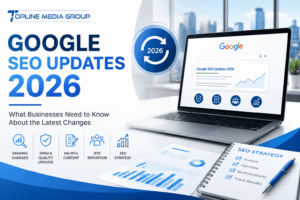
If you’re running an online business, managing digital marketing, or simply trying to stay ahead in the game, you’ve likely heard the buzz: Google is changing how search works. And yes — the changes coming into 2026 are not just incremental tweaks, they reflect a shift in how Google thinks about search, content, user experience, and even AI. In this article, I’ll walk you through what’s happening, what it means for your marketing, and what you should be doing to stay ahead.
The Change in the Google Algorithm Landscape
Let’s start with a quick overview: Google regularly updates its search algorithms — sometimes broadly, sometimes more narrowly. As of 2025, for example, Google’s “core updates” and “spam updates” continue to occur. Impression+3Search Engine Journal+3Google for Developers+3
But beyond the timing, what’s more important is what’s changing — the signals Google is prioritizing, and how it’s processing content.
Some of the major shifts include:
- A stronger emphasis on user experience, speed, mobile-friendliness and what’s called “Core Web Vitals”. Dotin Digital Academy+1
- A move toward semantic understanding — not just “match the keyword” but “understand the searcher’s intent, context, and meaning”. Passionfruit+1
- Growing importance of what Google calls E-E-A-T (Experience, Expertise, Authority, Trustworthiness) — showing you’re credible and valuable. sitecentre.com.au+1
- The increasing role of generative AI, multi-modal search (images/videos), and what many are calling “Generative Engine Optimization (GEO)” — basically preparing for search and discovery in an AI-driven environment. Wikipedia+1
In short: the search game is evolving. For marketers, that means you can’t rely on old “keyword stuffing + backlinks only” tactics and expect to win. The expectations, signals, competition — everything — is shifting.
What It Means for Your Digital Marketing in 2026
Now let’s zoom into your digital marketing. If you’re doing SEO, content marketing, PPC, social media tied to search visibility — this section is for you. Here are the major take-aways and how to adapt.
1. Content Must Serve Real Human Intent — Not Just Keywords
In the past you might have focused on “keyword density”, exact matches, and building lots of superficially optimized pages. In the new world:
- You’ll want content that genuinely answers the user’s question, solves a problem, or fulfills intent. Google’s algorithm is better at detecting when a page really satisfies the user. First Page Sage+1
- That means topic clusters, comprehensive content, supporting visuals (images/videos), and structure that makes it easy for humans and machines to understand.
- Use conversational language, address related questions, anticipate follow-up queries. Because semantic search means Google is better at interpreting context and meaning beyond just keywords.
Bottom line: if your content isn’t helpful, usable, and trustworthy — its chances of ranking get much harder in 2026.
2. Technical & Experience Signals Are Table Stakes
You can’t ignore the technical side anymore. Google’s algorithm continues to reward sites that perform well and penalize ones that don’t. Things to prioritize:
- Page load speed, mobile responsiveness, layout stability (i.e., no annoying jumps) — the so-called Core Web Vitals.
- A clean site architecture, internal linking, clear navigation — so that both users and crawlers can easily access the content.
- Security (HTTPS), proper schema markup (yes it matters), structured data to help Google understand what your pages are about.
- Accessibility, good UX, low bounce rates — signals that visitors stay and engage matter more.
If your site is slow, outdated, hard to use on mobile, you’re already disadvantaged going into 2026.
3. Credibility, Authority, Trust = Non-Negotiable
With E-E-A-T growing in importance, you must show you deserve to rank. How do you show that? Some key tactics:
- Author names, credentials, company background when relevant (especially for “Your Money or Your Life” topics).
- Clear citations, references, transparent sourcing if you’re making claims.
- Build a history: consistent publishing of good content, not random posts. Google appears to reward “sites that regularly publish satisfying content”. First Page Sage+1
- Gain reputable links and mentions: quality over quantity. In earlier days backlink volume might’ve carried more weight; now the profile of those links matters a lot.
In 2026, if you’re a faceless website with no “who we are” or “why trust us” component — you’ll face uphill battle.
4. Prepare for AI & Synthesized Search Results
One of the biggest changes: Google is increasingly using AI-generated summaries, “answer boxes”, and features that reduce the traditional “10 blue links” approach. WIRED+2Wikipedia+2
What this means for you:
- The “search result” your content competes with isn’t just other websites—it may be an AI snippet, a generative response, a multimodal answer.
- You’ll need to optimize for visibility in those AI-driven contexts: being referenced as a credible source, structured data, being scannable by machines.
- Think about different touch-points: your content may be used for voice search, snippet answers, image or video results.
- Metrics change: not just “rank #1 on page”, but “does our content get cited or summarized?”, “do we appear in the AI overview?” etc.
In 2026, ignoring AI’s impact on search is risky. It’s not just a “nice to have” — it’s becoming central.
5. Local & Mobile Still Matter — They’re Amplified
For businesses serving local markets (and even national ones), the local and mobile signals remain highly relevant — and they’re only becoming more important:
- More searches on mobile + voice mean that mobile optimization is mandatory, not optional.
- Local SEO: Google puts heavier weight on “near me” queries, map pack results, local business listings. If your business doesn’t show up locally, you lose.
- Reviews, local citations, staying current with Google Business Profile and similar mechanisms.
So if you serve a region (city, county, state) this local focus needs to integrate into your SEO strategy for 2026.
6. Data & Analytics: New KPIs for a Changing Environment
Because the search landscape is shifting, your metrics must shift as well. Instead of just “sessions” and “rankings”, you’ll want to measure:
- Engagement metrics (time on page, scroll depth, bounce rate) as indicators of satisfaction.
- Visibility in non-click “search” contexts (for example AI snippets, voice results).
- Citation/reference frequency (how often your brand or site is referenced).
- Conversion at the page level — not just traffic volume, but traffic quality.
- Technical health metrics (site speed, mobile usability) to ensure you’re not penalized.
If your analytics setup is still just “track rankings + traffic” with zero nuance — the insights you need for 2026 will be missing.
What to Do Right Now to Prepare for 2026

You’ve heard what’s changing, now let’s talk action. Here’s a roadmap you can follow to align your digital marketing for success.
1. Audit Your Site & Content
- Check your site speed, mobile usability, Core Web Vitals. If you’re lagging — fix immediately.
- Review your content: is it truly helpful, deep enough, written for humans (not just machines)?
- Identify thin or outdated pages and either update or remove them.
- Ensure your site has clear branding, authorship (where relevant), trust signals.
- Review your backlink profile: any spammy links? Any low-quality sites? Clean up.
2. Build Topic Clusters & Semantic Depth
- Instead of many thin pages each targeting one keyword, consider clusters of pages around a theme. For example: “Ultimate Guide to [Your Topic]”, plus supporting articles that link together.
- Use semantic keywords — related terms, synonyms, questions. This helps Google understand relevance beyond exact match.
- Make sure your structure allows for easy internal linking between supporting content and your “pillar” content.
- Include visuals, videos, structured data (Schema) where relevant.
3. Strengthen Your Authority & Trust Signals
- Highlight credentials: Who wrote the content, what expertise do they have?
- Get mentions and links from reputable sources in your niche. Outreach, contribute guest posts, collaborate.
- Encourage reviews, testimonials, case studies — especially if you’re local or service-based.
- Be consistent: publish regularly, maintain a content calendar, show you’re active and engaged.
4. Optimize for AI-Driven Search & Multi-Modal Formats
- Consider how your content might be featured in “answer boxes”, “AI overviews”, voice results.
- Provide clear headings, FAQs, structured data markup for questions and answers.
- Optimize images and videos: meaningful alt text, captions, transcripts (for video/audio).
- Think about mobile and voice – shorter queries, conversational phrasing (“How do I fix X?” rather than “fix X manual”).
- Monitor for how your content is performing in snippet / overview contexts, and adjust.
5. Prioritize Local & Mobile Strategies (if relevant)
- For local businesses: ensure your Google Business Profile is claimed, optimized, updated.
- Make sure NAP (Name, Address, Phone) info is consistent across the web.
- Focus on “near me”, “city-based” keywords, local content that reflects your service area.
- Mobile-first design: ensure your site is fully usable, fast, and easy to navigate on a smartphone.
6. Revise Your Analytics & KPI Framework
- Set up dashboards that track engagement, conversion actions (not just raw visits).
- Add tracking for “featured snippet impressions”, “voice search traffic”, “multi-device performance”.
- Monitor site health, technical errors, crawl issues.
- Regularly review what pages are performing (and why) — and allocate resources accordingly.
Why Ignoring These Changes Could Be Costly
If you treat your digital marketing like it did in 2018 or 2020 — focusing primarily on keyword density, building high volume spammy backlinks, ignoring technical/UX issues — you run several risks:
- You may lose rankings as Google shifts weight to different signals.
- You may miss traffic because your site may not meet new expectations for user experience or intent.
- Your brand authority may erode if you don’t show up in the “trusted” category that Google increasingly favors.
- You may waste budget on content that doesn’t convert or on SEO tactics that no longer carry the same weight.
- You may be left behind, giving competitors who adapt faster the advantage.
When search changes, the cost of standing still is real. For businesses dependent on search visibility, the stakes are high.
Final Thoughts: The Future Is Now
In 2026, digital marketing is less about “hacking the algorithm” and more about doing the fundamentals very well — combined with flexibility for the new realities (AI, mobile, user experience, trust).
The algorithm is not just a “what keyword do I target” game anymore — it’s about helping humans, earning trust, working technically, and being ready for AI-driven discovery.
So if I were giving you one piece of advice: Start today. Audit your presence. Improve your site experience. Build content that truly serves your audience. Prepare for the shift. Because when the algorithm favors value, relevance, and trust — the winners will be those who already embraced those qualities.