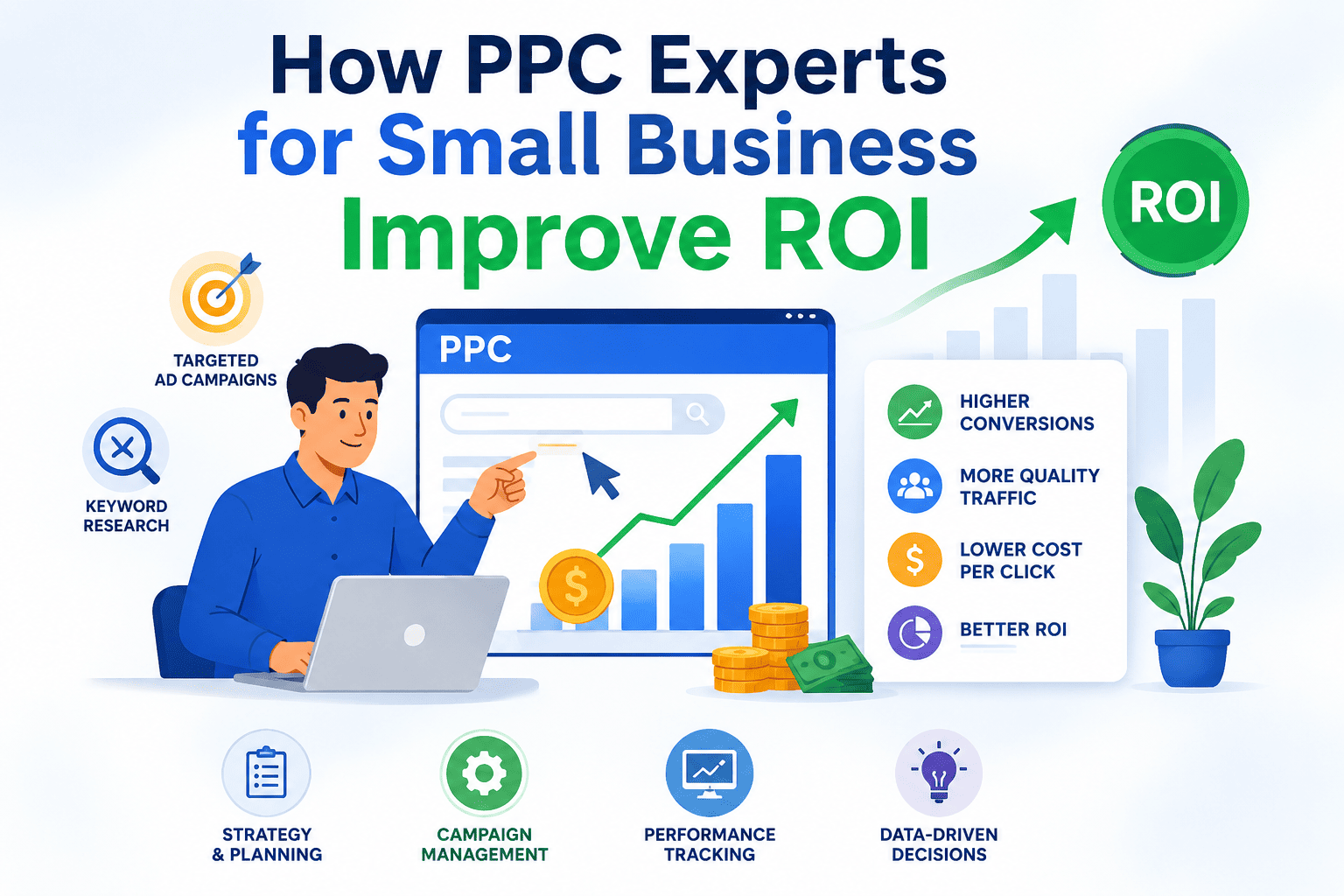
PPC experts for small business help companies turn paid advertising budgets into measurable leads, sales, appointments, and revenue.
Launching an advertising campaign is relatively easy, but generating a profitable return requires more than selecting keywords and writing a few ads.
Small businesses must reach the right customers, control costs, create persuasive messages, provide useful landing pages, and track what happens after each click.
A campaign can appear successful because it receives traffic while still producing few valuable customers.
For that reason, PPC performance should be measured through cost per lead, conversion rate, lead quality, revenue, and customer value rather than clicks alone.
What PPC Experts Do for Small Businesses
PPC experts plan, manage, measure, and refine paid advertising campaigns.
Their responsibilities may include campaign structure, search-term research, ad development, location settings, audience selection, bid management, conversion tracking, landing-page recommendations, and performance reporting.
The work begins with understanding the business rather than immediately creating ads.
An effective campaign plan should identify:
- The products or services being promoted
- The locations the business can serve
- The customers most likely to convert
- The actions that should count as conversions
- The approximate value of a lead or sale
- The maximum amount the business can afford to pay for a result
These details help establish realistic performance goals. A campaign designed to generate online purchases requires a different structure from one intended to produce phone calls, consultations, or local service appointments.
Why PPC ROI Requires More Than Clicks
Clicks show that people interacted with an advertisement, but they do not confirm that the campaign produced business value.
A click may come from someone outside the service area, a job seeker, a person researching a school project, or a user looking for a service the company does not offer.
Even relevant traffic may fail to convert when the landing page is unclear or the offer does not match the search.
Return on investment should therefore be connected to outcomes that matter to the business.
A basic PPC return calculation is:
PPC ROI = (Revenue attributed to PPC − PPC costs) ÷ PPC costs × 100
PPC costs may include advertising spend, management fees, landing-page expenses, call-tracking tools, and other campaign-related costs.
For example, if a business spends $3,000 on a campaign and generates $9,000 in attributable gross profit, its return should be calculated from the profit created rather than the total sales amount alone.
This produces a more realistic view of campaign performance.
Cost per Lead
Cost per lead shows how much advertising spend is required to generate one inquiry.
It can be calculated as:
Cost per lead = Total advertising spend ÷ Number of leads
If a campaign spends $2,000 and generates 40 leads, the cost per lead is $50.
This metric becomes more useful when leads are separated by type. A phone call lasting several minutes may be more valuable than an incomplete form submission.
A request from someone within the service area may be more useful than an inquiry from a location the company cannot serve.
A low cost per lead is not automatically a sign of success. Cheap leads can still produce poor results when they are unqualified or unlikely to become customers.
PPC experts review both the cost and quality of each lead source.
Conversion Rate
Conversion rate measures the percentage of visitors who complete the desired action after clicking an advertisement.
It can be calculated as:
Conversion rate = Number of conversions ÷ Number of ad clicks × 100
If 200 people click an advertisement and 20 submit a form or call the business, the conversion rate is 10%.
A weak conversion rate may point to several possible problems:
- The advertisement is attracting the wrong audience.
- The landing page does not match the advertisement.
- The offer is unclear or uncompetitive.
- The page loads slowly.
- The form asks for too much information.
- The call to action is difficult to find.
- Visitors do not see enough trust or service information.
Improving conversion rate can produce more leads without increasing the advertising budget. This is often one of the most practical ways to improve PPC ROI.
Revenue Tracking
Lead generation is only one part of PPC measurement. Businesses also need to understand which leads become paying customers and how much revenue those customers produce.
Revenue tracking may connect advertising data with online sales, customer relationship records, appointment systems, call records, or sales reports.
For an online store, purchase value can often be recorded directly after checkout.
For a service business, the process may require matching phone calls and form submissions with completed jobs or signed contracts.
Without revenue tracking, two campaigns may appear equally valuable because they generated the same number of leads.
In reality, one campaign may produce small, low-margin jobs while the other creates larger and more profitable opportunities.
Tracking revenue helps businesses decide where the advertising budget creates the greatest financial return.
Customer Acquisition Cost
Customer acquisition cost measures how much it costs to gain one paying customer rather than one lead.
It can be calculated as:
Customer acquisition cost = Total campaign cost ÷ Number of new customers
Suppose a business spends $4,000, generates 80 leads, and converts 16 of those leads into customers.
The cost per lead is $50, but the customer acquisition cost is $250.
This distinction is important because not every lead becomes a sale. A campaign with a higher cost per lead may still be more profitable when those leads close at a stronger rate.
PPC experts may therefore review both advertising performance and sales outcomes before deciding which campaign deserves more budget.
Customer Lifetime Value
Customer lifetime value estimates the revenue or profit a customer may generate throughout the relationship with the business.
This is especially important for businesses that depend on repeat purchases, renewals, maintenance plans, subscriptions, or ongoing services.
A campaign may appear expensive based on the first purchase. However, it may still be profitable when customers regularly return or purchase additional services.
For example, paying $200 to acquire a customer may be reasonable when the average customer generates $1,500 in profit over several years.
The same acquisition cost may be unsustainable when the average sale produces only $100 in profit.
Customer value helps determine how much the business can responsibly spend to acquire a new customer.
How Campaign Structure Supports Better Performance
A well-organized campaign makes it easier to control spending and understand results.
Advertisements should be grouped according to closely related services, products, locations, or customer needs.
Each group should have messaging that directly reflects what the user searched for.
For example, a company offering several home services should not place every service in one broad group with the same advertisement.
Someone searching for an urgent repair should see a different message from someone researching a planned installation.
Clear campaign structure improves the connection among the search, advertisement, landing page, and offer. It also allows performance to be measured at a more useful level.
Instead of knowing only that the overall account generated leads, the business can identify which specific service, area, or message produced them.
Improving Ad and Landing-Page Alignment
An advertisement creates an expectation. The landing page must continue the same message.
When an ad promotes a specific service, the visitor should reach a page that clearly explains that service.
Sending all traffic to a general homepage may force users to search for the information they expected to see immediately.
A PPC landing page should usually provide:
- A clear description of the service or offer
- A visible phone number or form
- A direct call to action
- Relevant trust information
- Service-area details when applicable
- A fast and mobile-friendly experience
- Answers to common customer concerns
The page should also avoid distractions that move visitors away from the intended action.
PPC experts may compare landing-page versions to determine whether changes in headlines, forms, calls to action, or page structure improve conversion rate.
A Practical Small Business Optimization Example
Consider a local service business spending $3,000 per month on paid search.
During the first month, the campaign generates 300 clicks and 15 leads.
The initial results are:
- Average cost per click: $10
- Conversion rate: 5%
- Cost per lead: $200
- New customers: 3
- Customer acquisition cost: $1,000
A campaign review finds that a significant portion of the budget is being spent on informational searches and locations outside the company’s preferred service area. The landing page also uses a long form that many mobile visitors do not complete.
The campaign is refined by excluding irrelevant searches, narrowing the location settings, reorganizing the ads around the most profitable service, and simplifying the landing-page form.
The following month, the same $3,000 budget produces 250 clicks and 25 leads.
The revised results are:
- Average cost per click: $12
- Conversion rate: 10%
- Cost per lead: $120
- New customers: 8
- Customer acquisition cost: $375
The campaign receives fewer clicks and pays more for each click, but it produces more leads and customers.
This example shows why cheaper traffic is not always better. The more important question is whether the campaign attracts people who are likely to become profitable customers.
How PPC Performance Should Be Measured
PPC reports should connect platform activity with actual business results.
Useful performance measurements may include:
Ad Spend
Ad spend shows how much was paid directly to the advertising platform during the reporting period.
Click-Through Rate
Click-through rate indicates how often people clicked after seeing an advertisement. It can help evaluate whether the ad message is relevant, but it does not measure lead or sales quality.
Cost per Click
Cost per click shows the average amount paid for each visit. A higher cost may be acceptable when the traffic converts at a strong rate or generates high-value customers.
Conversion Rate
Conversion rate shows how effectively paid traffic completes the intended action.
Cost per Lead
Cost per lead helps compare campaigns, services, locations, and advertising periods.
Qualified Lead Rate
Qualified lead rate measures how many recorded inquiries meet the business’s customer criteria.
Lead-to-Customer Rate
This measurement shows what percentage of PPC leads become paying customers.
Customer Acquisition Cost
Customer acquisition cost reveals the actual cost of gaining a customer after accounting for leads that do not close.
Revenue and Profit
Revenue and profit tracking help determine whether the campaign is financially worthwhile.
Customer Lifetime Value
Customer lifetime value provides context for campaigns that generate repeat business or long-term customer relationships.
No single metric gives a complete picture. These measurements should be reviewed together.
When a Small Business May Need PPC Help
Professional support may be useful when a business is spending consistently but cannot connect advertising activity with calls, sales, appointments, o r revenue.
Other warning signs may include rising lead costs, declining lead quality, unclear reporting, inconsistent tracking, or significant differences between the number of recorded conversions and actual customer inquiries.
Expert support may also be valuable when a business launches a new service, enters another market, experiences seasonal changes, or wants to increase its budget without losing control of profitability.
The purpose of PPC management is not simply to keep campaigns active. It is to create a measurable process for attracting customers at a sustainable cost.
Conclusion
PPC experts for small businesses improve ROI by connecting advertising decisions with business outcomes.
Effective campaign management considers cost per lead, conversion rate, customer acquisition cost, revenue, profit, and customer lifetime value.
It also examines how advertisements, landing pages, tracking systems, and sales results work together.
A successful PPC campaign is not necessarily the one with the most traffic or the cheapest clicks.
It is the campaign that consistently produces qualified customers at a cost the business can afford.
Frequently Asked Questions
How do PPC experts improve small business ROI?
They improve ROI by refining campaign structure, strengthening the connection between ads and landing pages, tracking valuable actions, and directing the budget toward campaigns that produce qualified leads and customers.
What is a good cost per lead for a small business?
A good cost per lead depends on the company’s profit margins, close rate, service value, and customer lifetime value. The cost is sustainable when enough leads become profitable customers.
Should PPC success be measured by clicks?
Clicks are useful for understanding traffic, but they do not show whether the campaign produced sales or qualified inquiries. Conversion rate, customer acquisition cost, revenue, and profit provide stronger measures of performance.
What is the difference between cost per lead and customer acquisition cost?
Cost per lead measures how much is spent to generate an inquiry. Customer acquisition cost measures how much is spent to gain a paying customer after accounting for leads that do not convert.
How long does PPC optimization take?
Campaigns can begin producing data quickly, but meaningful optimization requires enough information to identify patterns. The timing depends on budget, search volume, competition, conversion volume, and the length of the sales process.