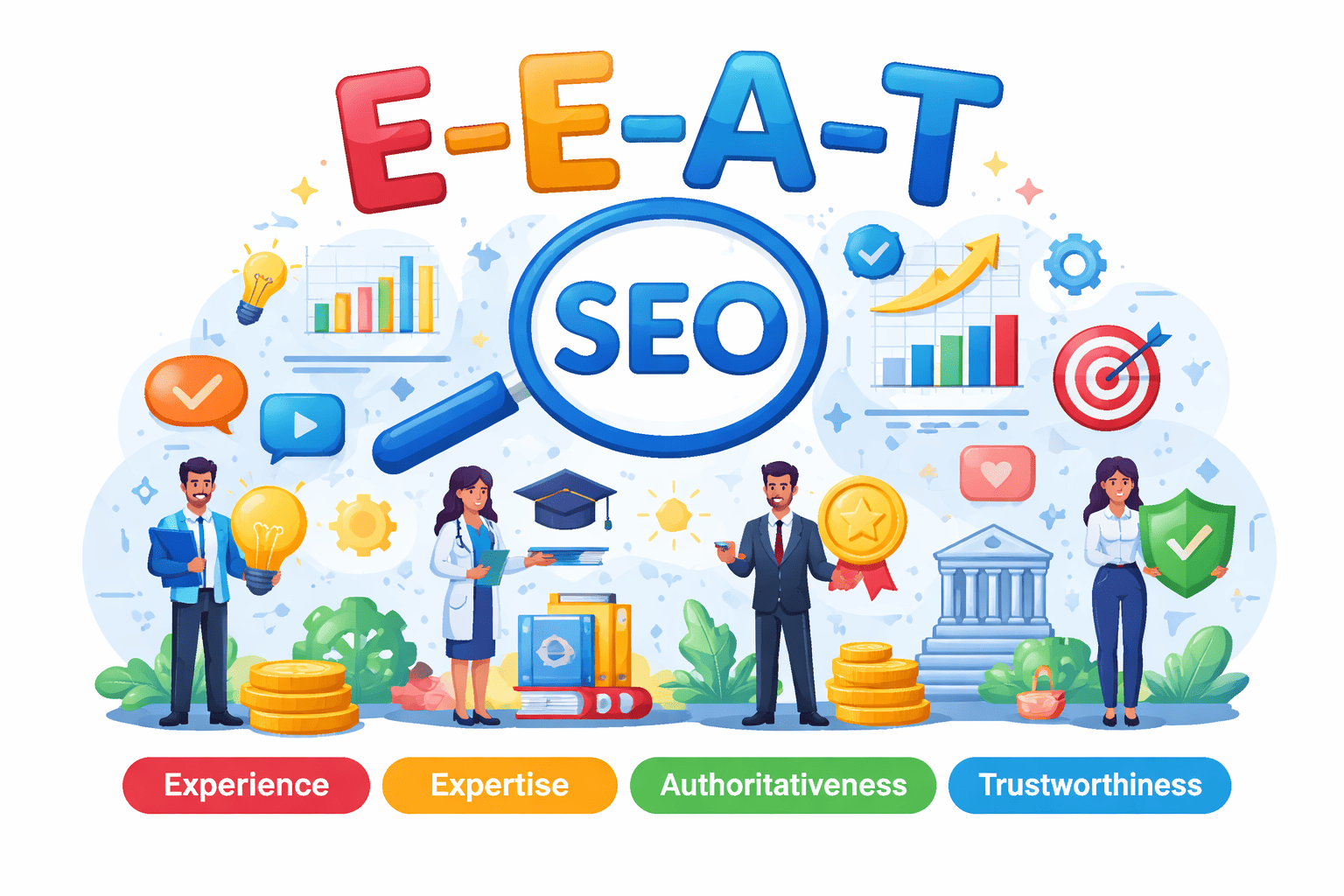
E-E-A-T SEO experiments have become a critical part of modern search optimization as Google places increasing emphasis on experience, expertise, authority, and trust when evaluating content quality.
As AI-generated content floods the web and search results become more competitive, brands and publishers are being pushed to prove credibility not just relevance.
This shift has sparked widespread testing around author pages, author bios, and broader trust signals to understand how they influence rankings, visibility, and long-term performance.
This article breaks down what E-E-A-T really means, what SEO experiments are revealing, and how businesses can implement scalable, practical E-E-A-T optimization strategies without keyword stuffing or artificial signals.
What Is E-E-A-T and Why Does Google Care?
E-E-A-T stands for Experience, Expertise, Authoritativeness, and Trustworthiness.
It evolved from the original E-A-T framework after Google added “Experience” to emphasize first-hand knowledge and real-world involvement.
Rather than acting as a single ranking factor, E-E-A-T influences how Google evaluates content quality, credibility, and reliability, especially in competitive or sensitive niches.
Industries such as health, finance, legal services, SaaS, and local service businesses are particularly affected by E-E-A-T signals.
Google’s systems increasingly prioritize content that demonstrates:
- Real experience with the topic
- Subject-matter expertise
- Clear authority within a niche
- Strong trust signals at both content and brand levels
Why SEO Professionals Are Running E-E-A-T SEO Experiments
The rapid rise of AI-generated content has made trust harder to assess algorithmically.
As a result, Google has shifted toward identifying human experience and credibility signals that distinguish valuable content from generic output.
SEO professionals are testing E-E-A-T optimization strategies to:
- Improve ranking stability rather than short-term spikes
- Protect sites from algorithm volatility
- Strengthen long-term topical authority
- Increase visibility in AI-driven search results
These experiments consistently show that E-E-A-T strengthens content resilience rather than acting as a quick ranking hack.
Author Pages as a Core E-E-A-T Signal
One of the most impactful E-E-A-T SEO experiments involves author pages.
An author page acts as a centralized trust asset that connects content to a real person with relevant experience and expertise.
Well-optimized author pages typically include:
- Clear professional background
- Industry experience and specialization
- Editorial role or responsibility
- Links to related content authored or reviewed
Author pages support author page in SEO by reinforcing topical authority across multiple articles, especially when internally linked from blog posts.
Key Elements of a High-Trust Author Page
To contribute meaningful E-E-A-T signals, author pages should include:
- A concise biography tied directly to the content topic
- Demonstrated experience, not generic credentials
- Evidence of authority such as publications, certifications, or leadership roles
- Transparency about editorial oversight or content review
When author pages are aligned with content themes, they consistently improve trust signals SEO without manipulating rankings.
Author Bios Inside Blog Content
Author bios embedded within blog posts serve a different purpose than full author pages.
They reinforce experience signals in SEO at the content level by immediately establishing credibility.
Unlike standalone author pages, in-content bios:
- Provide context at the point of consumption
- Strengthen trust before engagement metrics are recorded
- Help users understand why the author is qualified
What Author Bios Should Include for E-E-A-T
Effective author bios focus on relevance not just length. They should naturally include:
- First-hand experience statements
- Industry-specific expertise
- Market or geographic relevance when applicable
- Editorial responsibility or review role
Author bios that feel authentic and topic-aligned consistently outperform generic bios in SEO experiments.
Experience Signals Tested in E-E-A-T SEO Experiments
“Experience” is the most misunderstood element of E-E-A-T. It does not require personal storytelling, but it does require evidence of real involvement.
Successful E-E-A-T case studies consistently include:
- Practical examples and applied insights
- First-hand explanations of processes or outcomes
- References to real scenarios rather than abstract theory
- Visual or data-backed proof where applicable
Experience signals SEO works best when content is written from a practitioner’s perspective, not just an informational one.
Trust Signals Beyond Authors
While authorship is essential, it is only one layer of trust. Google also evaluates trust at the brand and website level.
Key trust signals SEO experiments focus on including:
- Transparent About pages
- Clear contact information
- Consistent brand messaging across platforms
- Editorial policies and content standards
Technical Trust Signals That Support E-E-A-T
Technical foundations reinforce credibility and reliability:
- Secure HTTPS implementation
- Author and organization schema markup
- Clear ownership and copyright indicators
- Accurate business information for local entities
These elements support content trustworthiness SEO without directly influencing keyword rankings.
What SEO Experiments Reveal About E-E-A-T Impact
E-E-A-T SEO experiments rarely show instant ranking boosts.
Instead, results appear as:
- Improved ranking consistency
- Stronger performance in competitive SERPs
- Higher engagement and lower bounce rates
- Increased inclusion in AI-generated search responses
Sites with strong expertise, authority, and trust in SEO frameworks are more resilient during algorithm updates.
Common Mistakes When Implementing E-E-A-T
Many sites fail to benefit from E-E-A-T due to poor execution or misunderstanding how trust signals are evaluated.
Common mistakes include:
- Using fake or exaggerated author credentials that lack real-world relevance
- Publishing thin or irrelevant author bios that do not demonstrate experience
- Treating E-E-A-T as a checklist rather than a long-term strategy
- Ignoring brand-level trust signals such as transparency, consistency, and editorial oversight
Google’s systems are designed to identify superficial trust signals and discount them, especially when they are applied inconsistently or without genuine expertise behind the content.
This is where experienced SEO professionals add value.
Professionals understand how to align authorship, content quality, brand trust signals, and technical foundations into a cohesive E-E-A-T strategy.
Rather than forcing credentials or over-optimizing bios, they focus on authentic experience, proper positioning, and sustainable implementation that strengthens credibility over time.
How to Build an E-E-A-T Strategy That Scales
Scalable E-E-A-T optimization focuses on alignment, not volume. Best practices include:
- Matching authors to topics they genuinely understand
- Creating reusable author page templates
- Updating existing content with experience-driven insights
- Standardizing editorial review processes
When integrated into content operations, E-E-A-T becomes a competitive advantage rather than an SEO burden.
This is why many brands choose to work with a top-rated SEO firm that understands how to align authorship, trust signals, and content quality for sustainable visibility.
Final Thoughts
E-E-A-T SEO experiments confirm that credibility, experience, and trust are no longer optional.
Author pages, author bios, and trust signals work together to strengthen content quality and long-term visibility.
Rather than chasing short-term rankings, E-E-A-T rewards brands that invest in real expertise and transparent publishing practices.
As search evolves toward AI-driven evaluation, trust will continue to separate sustainable sites from disposable content.
Building trust, experience, and authority online requires more than surface-level SEO tactics.
At TopLine Media Group, we help brands implement E-E-A-T optimization strategies that align with Google E-E-A-T guidelines, strengthen content trustworthiness, and support long-term search visibility.
From author pages SEO and author bios E-E-A-T to full-scale trust signal frameworks, our team focuses on sustainable growth, not short-term ranking tricks.
For more information, contact us and learn how we can help you build credible, resilient SEO strategies.
Frequently Asked Questions
What are E-E-A-T SEO experiments?
E-E-A-T SEO experiments analyze how experience, expertise, authority, and trust signals influence rankings, engagement, and visibility. These experiments focus on author pages, author bios, and content trustworthiness SEO rather than traditional keyword-only tactics.
Do author pages really help with SEO?
Author pages support author pages SEO by reinforcing topical authority and author credibility signals across related content. While they may not cause instant ranking boosts, they improve trust signals SEO and long-term ranking stability.
How do author bios contribute to E-E-A-T?
Author bios E-E-A-T elements help establish experience signals SEO at the content level. When bios clearly explain first-hand experience and expertise, they strengthen credibility before users engage deeply with the content.
Is E-E-A-T a direct ranking factor in Google?
E-E-A-T is not a single ranking factor, but it strongly influences how Google evaluates content quality. Google E-E-A-T guidelines guide quality assessments that impact visibility, especially in competitive and YMYL-related searches.
What industries benefit most from E-E-A-T optimization strategies?
Industries such as health, finance, legal services, SaaS, and local service businesses benefit most from expertise, authority, and trust in SEO. These niches require stronger credibility signals due to higher user risk and competition.
How does Google identify experience signals in content?
Google looks for real-world involvement through examples, practical explanations, and E-E-A-T case studies. Experience signals SEO are strongest when content reflects hands-on knowledge rather than purely theoretical information.
Can E-E-A-T replace backlinks as an SEO strategy?
No, E-E-A-T does not replace backlinks, but it complements them. Strong trust signals SEO and content credibility help differentiate sites when backlink profiles are similar, improving overall content evaluation.
How long does it take to see results from E-E-A-T SEO experiments?
E-E-A-T improvements typically deliver gradual results over weeks or months. Rather than short-term spikes, they improve content trustworthiness in SEO, ranking consistency, and resilience during algorithm updates.
Is E-E-A-T important for AI-generated content?
Yes, E-E-A-T is critical when AI-generated content is involved. Clear author credibility signals, experience-driven insights, and trust indicators help distinguish high-quality human-led content from generic AI output.