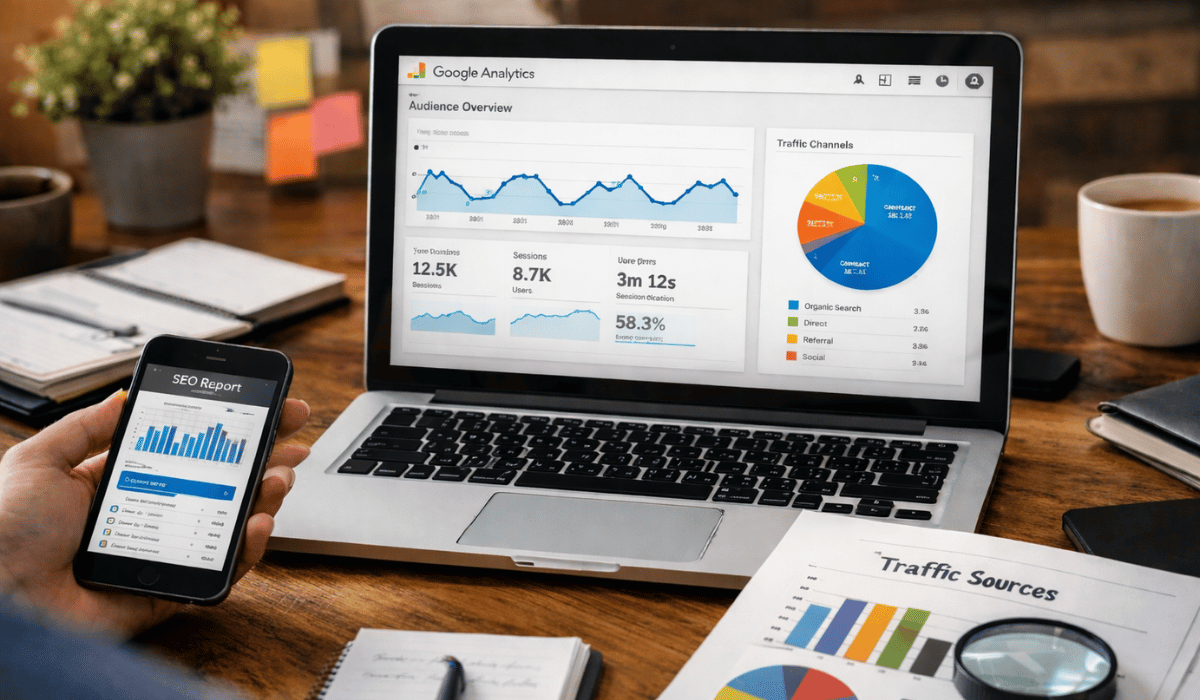
Google Analytics in SEO plays a critical role in how businesses measure, understand, and improve their organic search performance.
Ranking on Google is only part of the equation. What truly matters is how visitors behave once they land on your website and whether that traffic turns into real business value.
Many businesses invest in SEO without fully understanding what happens after users arrive from search engines.
Are visitors engaging with content? Are they finding what they expected? Are they converting into leads or customers?
These questions cannot be answered with rankings alone.
Google Analytics provides the behavioral and performance data needed to evaluate SEO beyond visibility.
It shows how organic traffic interacts with your website, which pages perform best, where users drop off, and how SEO contributes to revenue.
When configured correctly, it becomes the foundation of data-driven SEO decision-making.
This guide explains what Google Analytics in SEO is, how it works, and how businesses can use it to improve performance, user experience, and growth outcomes.
What Is Google Analytics?
Google Analytics is a free analytics platform provided by Google that tracks and reports website activity.
It collects data about visitors, sessions, user behavior, traffic sources, and conversions, helping businesses understand how users interact with their site.
At its core, Google Analytics works by placing a tracking code on your website.
This code records user interactions such as page views, clicks, scrolls, form submissions, and purchases.
The data is then processed and displayed in reports that show how people find and use your site.
The current version, GA4, uses an event-based model rather than traditional session tracking.
This allows more accurate measurement of user journeys across devices, platforms, and touchpoints.
For SEO, this shift provides deeper insight into engagement rather than surface-level traffic counts.
Google Analytics does not influence rankings directly.
Instead, it acts as a measurement and optimization tool that helps businesses understand how SEO traffic performs once it reaches the site.
Why Google Analytics in SEO Matters
SEO success is not defined by traffic alone. It is defined by engagement, relevance, and conversions.
Google Analytics in SEO helps businesses evaluate all three.
By analyzing organic traffic and behavior, businesses can determine whether their content matches search intent.
Pages with high traffic but low engagement often indicate misaligned keywords or poor content structure.
Pages with strong engagement and conversions highlight what is working and should be expanded.
Google Analytics also reveals how SEO traffic compares to other channels.
This helps businesses understand the true value of organic search within their marketing mix. Instead of guessing which pages drive results, decisions are backed by data.
Most importantly, analytics transforms SEO from a guessing game into a strategic growth channel.
Without it, businesses may rank well but fail to generate meaningful outcomes.
How Google Analytics Works for SEO
Google Analytics collects data through a tracking tag installed on your website.
Every user interaction triggers events that are processed and categorized into reports.
For SEO, the most important data source is organic search traffic.
Google Analytics identifies users who arrive via search engines and tracks how they behave across pages, sessions, and conversion points.
GA4 organizes this data around events rather than sessions. This allows businesses to measure actions such as scrolling, clicks, downloads, and form submissions more accurately.
It also provides better insight into cross-device behavior, which is essential for modern SEO analysis.
When connected with Google Search Console, Google Analytics helps bridge the gap between search visibility and on-site engagement.
Search Console shows how users find your site, while Analytics shows what they do afterward.
Key Google Analytics Metrics for SEO
Understanding which metrics matter is essential when using Google Analytics in SEO.
Not all data points are equally valuable.
Organic traffic shows how many users arrive from search engines.
While important, traffic alone does not indicate success.
Engagement metrics such as engagement time and engaged sessions reveal whether users find content useful.
Strong engagement often signals relevance to search intent.
Landing page performance identifies which SEO pages attract traffic and how well they retain users.
This helps prioritize content updates and optimization efforts.
Conversions measure real outcomes such as form submissions, calls, or purchases.
These metrics connect SEO performance to business results.
User behavior analytics highlights navigation paths, exit points, and friction areas.
These insights help improve site structure and user experience, both of which support long-term SEO health.
Setting Up Google Analytics for SEO Success
Proper setup is critical. Poor configuration leads to misleading data and ineffective decisions.
Start by installing GA4 correctly and verifying that events are firing as expected.
Conversion tracking should be set up for all meaningful actions, not just page views.
Internal traffic must be filtered to avoid skewed data.
Spam traffic and irrelevant referrals should also be excluded.
Connecting Google Analytics with Google Search Console is a best practice for SEO.
This integration allows businesses to analyze search queries alongside on-site engagement.
Custom reports and dashboards should be created to focus on SEO performance metrics rather than generic analytics views.
This ensures data is actionable and aligned with business goals.
How Google Analytics Supports SEO Strategy
Google Analytics in SEO provides clarity on what to improve, what to expand, and what to eliminate.
Content strategy becomes more effective when backed by performance data.
Pages that rank but fail to engage users can be rewritten or restructured. High-performing pages can be expanded into topic clusters.
Technical SEO improvements are easier to prioritize when analytics reveals user drop-offs, slow pages, or navigation issues.
These insights help focus efforts where impact is highest. Analytics also supports conversion optimization.
By analyzing how organic users move through funnels, businesses can reduce friction and increase lead quality.
Instead of reacting to rankings alone, businesses use analytics to refine SEO strategies continuously.
Common Mistakes Businesses Make with Google Analytics in SEO
Many businesses collect data but fail to use it effectively.
One common mistake is focusing only on traffic growth while ignoring engagement and conversions. More traffic does not always mean better SEO performance.
Another issue is incomplete GA4 setup. Missing events or untracked conversions lead to blind spots in SEO reporting.
Failing to integrate Search Console limits keyword and query insights. Ignoring user behavior analytics prevents businesses from identifying UX issues that affect SEO.
Without expert configuration and analysis, Google Analytics becomes a reporting tool rather than a growth driver.
How Google Analytics Helps Businesses Grow
Google Analytics in SEO helps businesses move from assumptions to informed decisions.
It shows which keywords and pages generate real value.
It highlights where users struggle and where they convert easily. It reveals patterns that guide smarter content creation and technical improvements.
For service-based businesses, analytics connects SEO to lead quality. For ecommerce, it ties organic traffic to revenue.
For local businesses, it identifies which pages drive calls and inquiries.
When analytics is aligned with SEO goals, businesses gain predictability, scalability, and long-term growth.
Turn Google Analytics in SEO Into Measurable Business Growth
Google Analytics in SEO only delivers results when it is configured, analyzed, and aligned with real business objectives.
At TopLine Media Group, we transform GA4 data into actionable SEO insights that drive qualified traffic, conversions, and revenue.
From advanced GA4 setup and Search Console integration to SEO dashboards, conversion tracking, and AI-search readiness, we help businesses use analytics as a strategic growth engine.
👉 Connect with us today and turn your Google Analytics data into a results-driven SEO strategy.
Frequently Asked Questions
Is Google Analytics in SEO important for business growth?
Yes, Google Analytics in SEO helps businesses understand how organic traffic behaves after landing on a website. It reveals engagement patterns, content performance, and conversion paths. This insight supports smarter SEO decisions that lead to sustainable growth.
Does Google Analytics directly improve search rankings?
Google Analytics does not directly affect rankings and is not a ranking factor. However, it helps identify engagement and usability issues that can weaken SEO performance. Fixing these issues often supports better long-term search visibility.
What SEO data can Google Analytics track?
Google Analytics tracks organic traffic, landing page performance, user behavior analytics, engagement time, and conversions. When connected to Search Console, it also helps align search queries with on-site behavior.
How does GA4 support modern SEO analysis?
GA4 uses an event-based tracking model that captures user interactions across devices and sessions. This provides deeper insight into engagement and conversion behavior, making SEO analysis more accurate and future-ready.
Can Google Analytics measure SEO ROI?
Yes, Google Analytics connects organic traffic to conversions such as form submissions and purchases. This allows businesses to evaluate the real return on SEO efforts rather than focusing only on rankings or visits.
Why should Google Analytics be connected with Search Console?
Search Console shows how users find your site, while Google Analytics shows what they do afterward. Connecting both provides a complete SEO performance view, helping refine keyword targeting and content strategy.
What are common Google Analytics mistakes that hurt SEO insights?
Common mistakes include improper GA4 setup, missing conversion tracking, unfiltered internal traffic, and ignoring engagement metrics. These issues distort SEO data and lead to poor decision-making.
How often should Google Analytics SEO data be reviewed?
SEO analytics should be reviewed monthly for trends and weekly for high-impact websites. Regular monitoring helps identify performance issues early and maintain consistent organic growth.
How can an SEO agency improve Google Analytics reporting?
An SEO agency configures GA4 correctly, builds SEO-focused dashboards, and aligns analytics with business goals. This ensures data supports optimization decisions rather than functioning as basic reporting.