AI search optimization is becoming essential as businesses realize that SEO alone isn’t enough in the age of AI-powered search.
Even companies that are doing everything right are seeing declining visibility, fewer clicks, and increasingly unpredictable results.
Rankings still matter, but they no longer tell the full story of how people discover information online.
As search has evolved, users are now looking for answers rather than simply finding websites.
Today, people expect information to be delivered directly by AI-powered systems, often without the need to click through to a webpage.
This doesn’t mean SEO is dead, but it does mean SEO can no longer stand alone.
To remain visible, credible, and competitive, brands must understand how AI search works, what it values, and how optimization strategies need to evolve alongside it.
This guide explains what has changed, why traditional SEO has limits in today’s search environment, and what businesses should do next to stay relevant.
How AI-Powered Search Is Changing the Way People Find Information
Search used to be simple. You typed in a query, scanned a list of links, and clicked the most relevant result. Today, that experience looks very different.
AI-powered search tools now interpret intent, summarize information, and present direct answers at the top of results.
Users ask longer, more conversational questions and expect immediate clarity.
Instead of browsing multiple pages, many people stop at the first AI-generated response that feels accurate and trustworthy.
This shift has changed user behavior in fundamental ways:
- Fewer clicks on organic listings
- More “zero-click” searches
- Greater reliance on summarized answers
- Increased trust in AI-curated information
Search engines are no longer just matchmakers between queries and pages. They are becoming decision-makers—choosing what information to present, how to phrase it, and which sources to trust.
Why Traditional SEO Still Matters But Can’t Stand Alone Anymore
It’s important to be clear about one thing: traditional SEO (search engine optimization) still matters and helps in improve rankings and visibility.
Technical health, site structure, crawlability, internal linking, and authority signals remain foundational.
Without them, AI systems may never find or understand your content in the first place.
SEO helps ensure:
- Your pages are discoverable
- Your site is technically sound
- Your content is indexed and categorized
- Your brand demonstrates authority
However, traditional SEO was built for ranking pages, not for answering questions in real time.
Ranking well does not guarantee that your content will be selected, summarized, or referenced by AI-powered search systems.
In other words, SEO gets you into the conversation. AI decides whether you get quoted.
The Hidden Risk of an SEO-Only Strategy
Many businesses are confused right now. Their rankings look stable, but traffic is declining.
Their content is optimized, but engagement is dropping. The issue isn’t that they are not having performance, but the problem is they are facing visibility issues.
AI-powered search introduces new risks for SEO-only strategies:
- Content may be used without attribution
- Users get answers without clicking through
- Competitors may be cited instead, even with lower rankings
- Authority is evaluated holistically, not page by page
This creates a situation where businesses can “win” at SEO but still lose attention, influence, and conversions.
Relying solely on rankings in an AI-driven environment is like measuring success by foot traffic while everyone else has moved online.
The Real Factors that AI Search Engines Look for
To adapt effectively, it helps to understand how AI systems evaluate content.
Unlike traditional crawlers, AI-powered search engines don’t just scan for keywords or backlinks. They look for understanding.
AI systems prioritize:
- Clear, direct explanations
- Well-structured content
- Consistent topical coverage
- Demonstrated expertise
- Trustworthy, factual language
They favor content that answers questions thoroughly but efficiently.
Overall, promotional writing, vague generalizations, and keyword-heavy fluff are often ignored.
Simply, they take advantage of AI to bring clarity in content over cleverness.
Teaching AI to Utilize Your Content through Answer Engine Optimisation (AEO)
Answer Engine Optimization (AEO) focuses on structuring content so it can be easily extracted and presented as a direct answer.
This is critical in an environment where users increasingly rely on AI-generated responses.
AEO involves:
- Answering questions clearly and early
- Using natural, conversational language
- Structuring content with logical headings
- Including concise explanations before deep detail
Content optimized for AEO doesn’t just rank, but also teaches people about the information they are looking for online.
It helps AI systems understand exactly what question your content answers and why it’s reliable.
This approach improves visibility in featured snippets, AI summaries, and conversational search responses.
Generative Engine Optimization (GEO): Visibility Inside AI Responses
While AEO focuses on answers, Generative Engine Optimization focuses on presence. GEO (Generative Engine Optimization) is about ensuring your brand, expertise, and perspective are included when AI systems generate responses.
AI ranked well but lacked contextual depth. That’s why topical authority—covering a subject comprehensively rather than in isolated posts—matters more than ever.
GEO emphasizes:
- Consistent expertise across related topics
- Clear entity signals (who you are and what you do)
- Authoritative, experience-backed insights
- Content that fits naturally into AI-generated summaries
In AI search, being “the best answer” is often less important than being a trusted source.
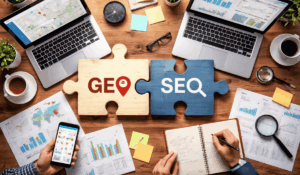
Why You Need All Three: SEO, AEO, and GEO
These strategies aren’t competing—they’re complementary.
SEO
SEO ensures discoverability. It helps search engines crawl, index, and rank your website so your content can be found in the first place.
Technical SEO, on-page optimization, and authority signals remain essential foundations for visibility across search platforms.
AEO
ensures clarity and answerability. AEO focuses on structuring content so search engines and AI systems can quickly understand and extract direct answers.
Clear explanations, well-organized headings, and question-based content make it easier for your information to appear in featured snippets, AI summaries, and conversational search results.
GEO
Generative Engine Optimization (GEO) ensures inclusion in AI-generated responses.
GEO goes beyond rankings and snippets by helping your brand and expertise become part of the answers AI systems generate.
It emphasizes topical authority, contextual depth, and consistent expertise so AI tools recognize your content as a trusted source worth referencing.
Together, they form a modern search visibility strategy that reflects how people actually search today.
Ignoring any one of these creates gaps either in rankings, answers, or AI visibility.
Make sure each strategy plays a distinct role in modern search visibility and they reflect how people actually search today, whether by asking questions, expecting instant answers, or relying on AI-curated information.
Ignoring any one of these creates gaps. Even if your site achieves strong rankings, your business can still lose visibility.
That’s why it’s essential to combine SEO, AEO, and GEO into a single strategy.
All of these make easier for your business to support discoverability, deliver clear answers, and ensure your brand isn’t left out of AI-generated summaries.
Is Your Content Ready for AI Search?
👉 If your pages rank well but aren’t showing up in AI summaries or answer-based results, it may be time to evaluate how AI-friendly your content really is.
A focused content audit can reveal whether your site is structured for today’s search reality.
How Content Needs to Evolve for AI-Powered Search
AI search has raised the bar for content quality. It’s no longer enough to publish frequently or target keywords aggressively. Content must be genuinely helpful.
Modern AI-ready content:
- Uses plain language
- Explains concepts clearly
- Anticipates follow-up questions
- Demonstrates real experience
- Is structured for skimming and extraction
This doesn’t mean dumbing content down. It means making expertise accessible.
When content reads like it was written to help a real person—not a search engine—it performs better in AI-driven environments.
How to Measure Visibility When Rankings Aren’t the Whole Story
Traditional SEO metrics don’t capture the full picture anymore. Rankings and traffic still matter, but they don’t show whether your brand is influencing AI-generated results.
New indicators to watch include:
- Brand mentions in AI tools
- Visibility in AI summaries
- Assisted conversions
- Engagement quality over volume
Search success today is about presence, not just position.
What Businesses Should Start Doing Now
Adapting to AI-powered search doesn’t require abandoning SEO. It requires expanding it.
With a professional digital marketing agency, you can work on next steps, including:
- Updating existing content for clarity and structure
- Building topic clusters instead of isolated pages
- Adding question-based explanations where appropriate
- Aligning SEO, AEO, and GEO into one strategy
Businesses that make these changes early will benefit from compounding visibility as AI search continues to evolve.
Do You Want Future-Proof Your Search Strategy
Search is changing faster than most strategies can keep up.
If your visibility still depends on SEO alone, now is the time to future-proof your content for AI-powered search before competitors do it first. For more information, schedule a call today.
Final Thoughts
SEO isn’t disappearing, but it’s evolving in 2026. In the age of AI-powered search, SEO becomes the foundation, not the finish line.
The brands that succeed won’t be the ones chasing algorithms.
They’ll be the ones focused on clarity, credibility, and genuinely helping their audience.
The goal is no longer just to rank, but it is to be the answer so that people come again, prioritize your information, and choose your services.
Frequently Asked Questions
What is AI search optimization?
AI search optimization is the process of optimizing content so it performs well not only in traditional search rankings but also in AI-powered search results. It focuses on clarity, structure, and authority so AI systems can understand and use your content. This approach goes beyond keywords to emphasize answers and context.
Why isn’t traditional SEO enough anymore?
Traditional SEO focuses on rankings and traffic, but AI-powered search often delivers answers directly without requiring clicks. Even well-ranked pages can lose visibility if they aren’t structured for AI understanding. SEO is still important, but it must be supported by newer optimization strategies.
How does AI-powered search change user behavior?
AI-powered search changes behavior by prioritizing instant answers over website visits. Users now expect quick, conversational responses instead of browsing multiple pages. This shift reduces clicks and increases the importance of being included in AI-generated summaries.
What is Answer Engine Optimization (AEO)?
Answer Engine Optimization (AEO) focuses on structuring content so search engines and AI tools can extract clear, direct answers. It relies on well-organized headings, concise explanations, and question-based formatting. AEO improves visibility in featured snippets and AI summaries.
What is Generative Engine Optimization (GEO)?
Generative Engine Optimization (GEO) helps ensure your brand and content are included in AI-generated responses. It emphasizes topical authority, consistent expertise, and contextual depth. GEO increases the chances of being referenced by AI tools even when users don’t click links.
How do SEO, AEO, and GEO work together?
SEO ensures your content is discoverable, AEO makes it easy for AI systems to extract answers, and GEO helps your brand appear in AI-generated summaries. Together, they create a complete search visibility strategy. Ignoring one creates gaps in rankings, answers, or AI exposure.
Does AI search optimization replace SEO?
No, AI search optimization does not replace SEO—it builds on it. SEO remains the foundation for crawlability and indexing. AI search optimization expands that foundation to include answer visibility and AI-generated search results.
How can businesses start optimizing for AI search?
Businesses can start by improving content clarity, answering common questions directly, and building topic authority. Updating existing pages for structure and readability is often more effective than creating new content. Aligning SEO, AEO, and GEO is the key first step.
Is AI search optimization important for small businesses?
Yes, AI search optimization is important for businesses of all sizes. AI-powered search often highlights the clearest and most helpful answers, not just the biggest brands. Smaller businesses with well-structured, authoritative content can compete effectively.