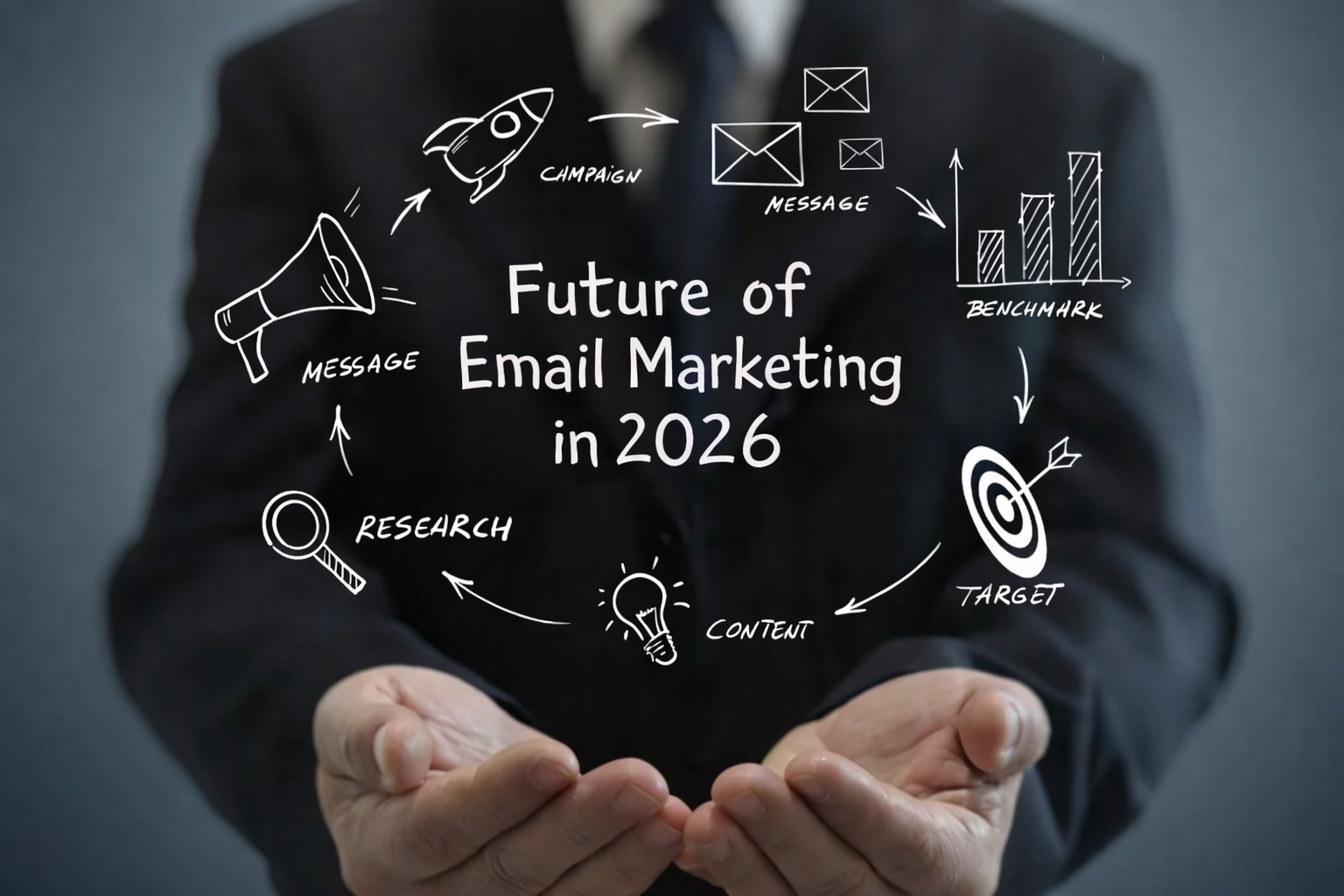
The future of email marketing is being shaped by smarter technology, stricter privacy standards, and rising expectations for relevance in every inbox interaction.
Email is no longer a volume-based channel driven by mass campaigns; it has evolved into a precision communication tool built on data intelligence, consent, and timing.
As we move into 2026, brands that rely on generic messaging or outdated automation models are seeing engagement decline, while those investing in personalization, AI-driven optimization, and lifecycle-focused email marketing are gaining measurable advantages.
This shift reflects a broader change in digital behavior, where subscribers expect value, context, and respect—not just promotions.
This guide explores the most important email marketing trends to consider in 2026 and explains how businesses can adapt their email strategy to stay visible, compliant, and effective in a rapidly changing digital environment.
Why Email Marketing Still Dominates in 2026
Despite constant predictions of decline, email continues to deliver one of the highest returns among digital channels. The difference in 2026 is how email is used.
Consumers now expect emails to:
- Reflect their preferences and behaviors
- Arrive at the right moment, not just the right message
- Respect consent and data transparency
- Integrate naturally with other brand touchpoints
Brands that rely on outdated tactics, such as static lists, generic messaging, or excessive automation are seeing engagement drop.
Those embracing smarter email marketing trends are building stronger long-term relationships.
How the Future of Email Marketing Is Being Redefined
Email marketing is shifting from campaign-centric thinking to lifecycle-centric strategy.
Instead of asking “What email should we send?”, marketers are asking “What does the subscriber need now?”
This shift is driven by:
- Advanced AI and machine learning
- Stricter privacy and consent standards
- Rising expectations for personalization
- Better integration between email, CRM, and analytics platforms
AI Email Marketing Becomes Core Infrastructure
Email marketing strategy in 2026 focuses on experience orchestration rather than message volume.
Artificial intelligence is no longer a supporting feature within email platforms.
It is the engine that powers how modern email programs operate. In 2026, AI email marketing systems are responsible for deciding when messages are sent, what content is shown, who receives it, and how often communication occurs.
This shift allows brands to move away from static rules and manual testing toward adaptive, data-driven decision-making that evolves with subscriber behavior.
Below are the core areas where AI is fundamentally changing how email marketing performs.
Predictive Send-Time Optimization at the Individual Level
AI enables predictive send-time optimization by analyzing each subscriber’s engagement history instead of relying on generic “best time to send” benchmarks.
Emails are delivered when individual users are most likely to open and interact, improving engagement rates while reducing inbox fatigue.
These models continuously adapt as behavior changes, ensuring long-term relevance.
Scalable Subject Line and Content Optimization
Content testing has evolved beyond limited A/B experiments.
AI evaluates subject lines, preview text, layouts, and calls to action at scale, automatically identifying combinations that perform best for different audience segments.
This allows email content to dynamically adjust based on real-time performance rather than static creative decisions.
Real-Time Segmentation Driven by Engagement Signals
Traditional segmentation relies on fixed rules that quickly become outdated.
AI-driven segmentation uses live engagement data, browsing behavior, and lifecycle signals to continuously update audience groups.
Subscribers move between segments automatically as their actions change, keeping messaging aligned with current intent.
Intelligent Frequency and Cadence Management
AI improves email frequency by identifying individual tolerance thresholds.
Subscribers who engage regularly may receive more communications, while those showing early signs of fatigue are automatically limited.
This personalized cadence reduces unsubscribes, protects deliverability, and improves overall list health.
AI Insights That Strengthen Human Strategy
Rather than replacing human decision-making, AI removes guesswork.
Marketers gain clearer insight into what content resonates, when subscribers are most responsive, and where friction appears within the lifecycle.
These insights support smarter optimization of onboarding, re-engagement, and retention workflows.
Many modern platforms demonstrate that AI’s real value lies in unifying data, timing, and personalization into a single intelligent system.
In 2026, brands that treat AI as foundational infrastructure not a standalone feature will deliver more relevant, scalable, and performance-driven email experiences.
Personalized Email Marketing Moves Beyond Surface-Level Tactics
Personalization in 2026 is no longer about first names or basic demographics.
Modern personalized email marketing is contextual, behavioral, and intent-driven.
Advanced personalization includes:
- Content blocks that adapt based on browsing or purchase history
- Offers triggered by lifecycle stage rather than calendar dates
- Messaging that reflects past engagement depth
- Dynamic layouts based on device and interaction patterns
When personalization is done correctly, emails feel timely and relevant rather than intrusive.
Zero-Party Data Becomes the Most Valuable Asset
With third-party data disappearing and cookies losing reliability, zero-party data email marketing has emerged as a critical strategy.
Zero-party data is information that subscribers willingly share, such as:
- Preferences
- Interests
- Communication frequency choices
- Product or content priorities
Brands are using interactive forms, preference centers, and surveys to collect this data transparently.
This approach improves trust while enabling more precise segmentation and messaging.
Interactive Email Marketing Gains Practical Adoption
Interactive email marketing is becoming more refined in 2026.
Instead of flashy features that hurt deliverability, brands are using lightweight interactivity that improves engagement without breaking inbox compatibility.
Common interactive elements include:
- Embedded polls or feedback prompts
- Click-to-reveal content sections
- Image carousels and product previews
- Appointment or demo selection buttons
These features keep subscribers engaged inside the inbox while providing valuable behavioral signals.
Email Automation Shifts Toward Lifecycle Intelligence
Email automation trends in 2026 emphasize adaptability rather than rigid workflows.
Static drip campaigns are being replaced by event-driven sequences that respond to real behavior.
Lifecycle-focused automation supports:
- Smarter onboarding experiences
- Behavior-based re-engagement paths
- Retention-driven messaging
- Upsell and cross-sell timing aligned with usage signals
Automation is now evaluated by contribution to lifetime value, not just open or click rates.
Deliverability Becomes a Strategic Advantage
Inbox placement is more competitive than ever.
Email deliverability trends show that engagement quality matters more than sending frequency.
Key deliverability priorities include:
- Strong authentication and domain reputation
- Consistent engagement signals
- Regular list hygiene and suppression
- Balanced send volume
Brands that treat deliverability as a technical afterthought struggle to maintain visibility.
Those that manage it proactively gain a measurable advantage.
Privacy and Consent Shape Every Email Marketing Decision
Privacy is a compliance checkbox, and it is a brand differentiator. In 2026, email privacy compliance impacts:
- List growth strategies
- Data collection methods
- Personalization depth
- Long-term trust
Clear consent flows, transparent messaging, and respectful data use improve both engagement and retention.
As personalization and automation increase, the risk of email fatigue grows when relevance and restraint are overlooked.
High-performing brands in 2026 are focusing on message quality, intent alignment, and value-driven communication rather than volume-based sending.
Creating email marketing content that respects subscriber attention is essential for maintaining trust and long-term engagement.
Subscribers reward brands that treat privacy as part of the customer experience.
Omnichannel Email Strategy Becomes Essential
Email does not operate in isolation. A modern omnichannel email strategy connects inbox communication with SMS, paid media, CRM systems, and customer support.
Email plays a central role by:
- Acting as a persistent, owned communication channel
- Reinforcing messages seen on other platforms
- Capturing engagement data that informs cross-channel decisions
The most effective strategies align timing and messaging across channels without overwhelming the user.
B2B and B2C Email Marketing Trends in 2026
While the fundamentals overlap, B2B and B2C email marketing trends diverge in execution.
B2B email marketing trends focus on:
- Longer decision cycles
- Account-based personalization
- Educational and trust-building content
B2C email marketing trends emphasize:
- Real-time behavioral triggers
- Emotional relevance
- Speed and convenience
Understanding these differences ensures messaging aligns with buying behavior.
Email’s Role in a Zero-Click and AI-Driven Search World
As AI-generated search results reduce organic clicks, email becomes a critical direct channel.
Email helps brands:
- Maintain direct audience access
- Distribute content without algorithm dependency
- Reinforce authority and brand recall
- Support conversion paths outside search
This makes email marketing strategy in 2026 more valuable, not less.
Platforms Supporting the Future of Email Marketing
Modern platforms are evolving to support these trends. Providers are integrating AI, automation, and CRM-driven intelligence into email workflows.
Choosing the right platform requires evaluating:
- AI capabilities
- Data integration flexibility
- Deliverability controls
- Scalability for future growth
How Email Marketing Success Is Measured in 2026
Email performance measurement has undergone a fundamental shift as inbox behavior, privacy changes, and AI-driven optimization reshape how success is defined.
Traditional metrics such as open rates and raw click counts no longer provide enough insight to guide strategic decisions.
In 2026, brands are focusing on impact, not activity, using measurement frameworks that reflect how email contributes to long-term business outcomes rather than short-term engagement spikes.
This evolution aligns with modern guidance from industry leaders such as MarketingProfs, which emphasize that effective email measurement must connect engagement data to real customer value.
Engagement Depth Matters More Than Surface Metrics
Opens alone offer limited insight, especially as privacy protections and automated image loading reduce their reliability.
Instead, marketers are evaluating engagement depth, including time spent reading, scroll behavior, secondary clicks, and interaction with dynamic elements.
These signals reveal whether subscribers are actually consuming content or simply triggering passive interactions.
Deeper engagement metrics help identify content quality, relevance, and message clarity, allowing teams to optimize creative strategy rather than chasing inflated vanity numbers.
Lifecycle Contribution Replaces Campaign-Level Reporting
Email is no longer evaluated campaign by campaign.
Performance is measured based on how email supports the entire customer lifecycle from onboarding and activation to retention and re-engagement.
This approach highlights which messages accelerate progression, reduce friction, or recover stalled users.
By mapping email performance to lifecycle stages, marketers gain clarity on which workflows create momentum and which need refinement.
Revenue Influence Becomes a Core KPI
In 2026, email success is increasingly tied to revenue influence rather than isolated conversions.
This includes assisted conversions, repeat purchases, upsell performance, and revenue velocity over time.
Email attribution models now account for how messaging supports decision-making across multiple touchpoints, not just last-click actions.
This shift allows email marketing to be evaluated as a growth driver rather than a supporting channel.
Retention and Churn Reduction Define Long-Term Value
Retention has become one of the most important indicators of email effectiveness.
High-performing email programs reduce churn by reinforcing value, improving onboarding clarity, and maintaining consistent engagement.
Metrics such as repeat engagement frequency, inactive subscriber recovery, and unsubscribe suppression provide insight into long-term list health.
Email strategies that improve retention ultimately reduce acquisition costs and increase lifetime value.
Smarter Measurement Enables Smarter Optimization
By focusing on engagement quality, lifecycle impact, revenue contribution, and retention, marketers can make more informed optimization decisions.
Testing shifts from surface-level tweaks to meaningful improvements in timing, relevance, and customer experience.
In 2026, measuring what matters in email marketing is not about tracking more metrics; it is about tracking the right ones.
Brands that align measurement with business objectives gain clearer insights, stronger performance, and more sustainable growth from their email programs.
Conclusion
The future of email marketing is not about sending more emails; it is about sending better ones.
Brands that succeed in 2026 will focus on relevance, respect, and intelligent orchestration across the customer lifecycle.
Email remains one of the most powerful digital channels, but only for those willing to evolve with it.
Ready to Build a Smarter Email Marketing Strategy?
If your email campaigns still rely on outdated segmentation or generic automation, now is the time to evolve.
Our team helps businesses design future-ready email marketing strategies built on personalization, privacy, and performance, so every send delivers real value.
Contact us today to transform your email program for 2026 and beyond.
Frequently Asked Questions
What is the future of email marketing in 2026?
The future of email marketing centers on personalization, AI-driven optimization, and privacy-first engagement. Brands are shifting from mass campaigns to lifecycle-based strategies that adapt to subscriber behavior and preferences.
Is email marketing still effective compared to newer channels?
Email remains highly effective because it is an owned channel with direct access to audiences. Unlike paid or social platforms, email allows brands to control messaging, timing, and data without algorithm dependency.
How does AI impact email marketing strategy?
AI improves email marketing by optimizing send times, personalizing content at scale, and identifying engagement patterns. It reduces manual testing while improving relevance and overall performance.
What role does privacy play in email marketing trends?
Privacy influences how data is collected, stored, and used. Consent-based strategies and transparent communication improve trust and long-term engagement while ensuring regulatory compliance.
What is zero-party data in email marketing?
Zero-party data is information subscribers voluntarily share, such as preferences or interests. It enables better personalization without relying on third-party tracking or invasive data collection.
How important is deliverability in 2026?
Deliverability is critical because inbox providers prioritize engagement quality. Poor list hygiene or excessive sending can limit visibility, regardless of content quality.
Are interactive emails worth using?
Interactive emails can increase engagement when used carefully. Simple elements like polls or click-based interactions work best without harming deliverability or accessibility.
How does email fit into an omnichannel strategy?
Email acts as a central communication and data hub within omnichannel strategies. It reinforces messages from other channels while capturing valuable engagement insights.
What metrics matter most for email marketing success now?
Modern email success is measured through engagement depth, lifecycle impact, and revenue contribution rather than open rates alone.